
Occurs when service staff do not deliver service to customers according to established criteria. The role of front-line staff is very important in creating service quality.
- Gap 4:
Advertising and communication media also influence customer expectations of service quality. Promises made in advertising and promotions may raise customer expectations, but they can also lower customer perceptions of service quality when they are not delivered as promised.
- Gap 5:
Occurs when there is a difference between the quality expected by the customer and the quality received. Service quality depends on this gap. Once the customer finds no difference between the quality expected and the quality perceived when consuming a service, the quality of the service is considered to be excellent.
Thus, service quality is a function of the fifth gap and this gap depends on the previous gap. Therefore, to shorten the fifth gap in Parasuraman's 5 gap model and increase service quality, the provider must make efforts to shorten this gap.
Service quality consists of five basic components:
- Tangible means: Expressed through brand, image, documents, equipment and machinery to perform the service and appearance and uniform of service staff.
- Reliability: Is the ability to provide services as committed to customers accurately and reliably, including stability and consistency that the company must commit to when launching products and services. Ensuring reliable service is one of the customer's expectations. Includes three parts:
+ Organizational commitments: Organizations make direct commitments to customers through marketing and advertising tools, in company correspondence and contracts, in insurance packages and service policies that are widely publicized.
+ General expectations: Before using the service, customers always set
basic service expectations.
+ Personal commitments: Direct words from the service provider to the customer
The goods will be performed to ensure service quality.
- Responsiveness: The level of desire and readiness to serve
customers in time.
- Service capacity (Assurance): Is the provision of service with a polite and respectful attitude towards customers, demonstrated through the expertise, service, polite style, enthusiasm of the service staff, readiness and especially the quick resolution of customer complaints and questions. The combination of attitude and capacity will create a sense of trust for satisfied and loyal customers. Includes 4 basic skills: Product knowledge, company knowledge, listening skills and problem solving skills.
- Empathy: Includes the ability to approach and make an effort to understand the needs of customers. Showing concern, kindness, encouragement, visiting, and individual attention to each customer. Different customers have different needs, expectations, attitudes, and emotions.
Cronin and Taylor's (1992) performance-based evaluation model
Based on the SERVQUAL model of Parasuraman et al. (1988), service quality is determined as follows: Service quality = Perceived level - Expected value. The scale of the SERVQUAL model consists of 2 parts, each part has 22 statements. The first part aims to determine customers' expectations for the type of service of the enterprise in general, the interviewees indicate their level of desire for the service and are not interested in any specific enterprise. The second part aims to determine customers' perceptions of the service performance of the surveyed enterprise, based on the specific service of the surveyed enterprise to evaluate.
But according to Carmen (1990), Babakus & Boller (1992), Cronin and Taylor (1992), the use of the SERVQUAL model as a basis for assessing service quality has caused much controversy. Cronin and Taylor (1992) with the SERVPERF model, argued that the level of customer perception of the service performance of the business best reflects service quality. According to the SERVPERF model: Service quality = Level of perception. Lee et al. (2000), Brady et al. (2002) agreed with this conclusion. Measuring service quality according to the SERVPERF model of Cronin and
Taylor is a clear convenience method. According to Cronin and Taylor's argument, the analytical framework of Parasuraman et al.'s SERVQUAL model (1985) is easy to confuse customer satisfaction and customer attitude. These two people believe that service quality can be understood as "similar to an attitude" and "actual performance" will determine better service quality than "performance according to expectations". Accordingly, service quality is assessed only through customer perception without an assessment of service quality in customer expectations, without weighting each service quality component. The SERVPERF scale uses 22 statements, but omits the expectation question, which is similar to the customer perception question in the SERVQUAL model. The SERVPERF model is used to assess customer perceptions of service quality, including 5 service quality characteristics:
- Reliability: Is the ability to perform the service on time and appropriately from the beginning.
- Responsiveness: Demonstrates the willingness of employees to achieve goals.
Provide customers with timely services.
- Service capacity (Assurance): Demonstrates expertise and service style
polite, friendly with customers
- Empathy: Showing care and concern for each individual
individual customer
- Tangible means: Shown through actual equipment and machinery.
service, appearance, uniform of service staff.
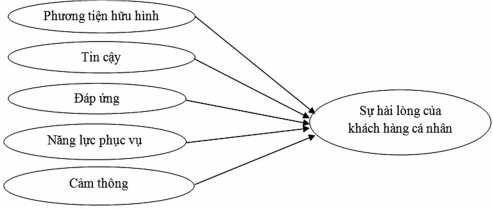
Figure 2.2. SERVPERF Model (Perception Level)
(Source: Cronin and Taylor, 1992)
Accordingly, the assessment of customer perceptions of service quality can be divided into 5 main groups: Assessment of the group of customers with perceptions related to the reliability characteristic, assessment of the group of customers with perceptions related to the responsiveness characteristic, assessment of the group of customers with perceptions related to the service capacity characteristic, assessment of the group of customers with perceptions related to the empathy characteristic, and assessment of the group of customers with perceptions related to the tangible means characteristic of service quality.
Gronroos's (1984) technical/functional quality assessment model
According to Gronroos, service quality is considered based on two criteria: functional quality (FSQ) and technical quality (TSQ) and service quality is strongly affected by corporate image. Thus, Gronroos has proposed three factors affecting service quality: functional quality, technical quality and corporate image (abbreviated as the FTSQ model).
1.1.3.2. Proposed research model
From the research models related to service quality, after analyzing the models related to SERVQUAL, SERVPERF model, the most suitable application to my topic, I decided to choose Cronin and Taylor's SERVPERF model as my research model.
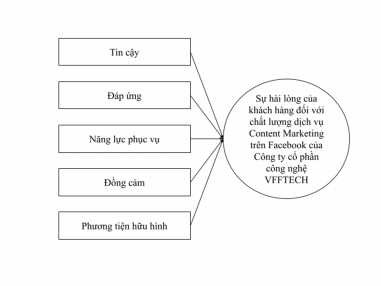
Figure 2.3. Proposed research model
(Source: Author's proposal)
The research hypothesis is stated as follows:
- Hypothesis H1: The Trust factor affects customers' perception of the quality of Content Marketing services at VFFTECH Technology Joint Stock Company.
- Hypothesis H2: The Responsiveness factor affects customers' perception of the quality of Content Marketing services at VFFTECH Technology Joint Stock Company.
- Hypothesis H3: The factor Service Capacity affects customers' perception of the quality of Content Marketing services at VFFTECH Technology Joint Stock Company.
- Hypothesis H4: The Empathy factor affects customers' perception of the quality of Content Marketing services at VFFTECH Technology Joint Stock Company.
- Hypothesis H5: Tangible Media factor affects customers' perception of Content Marketing service quality at VFFTECH Technology Joint Stock Company.
Building the scale:
Based on the proposed research model and the authors' studies on customer perceptions of service quality, I proceed to build the following scale:
Table 1.1. Original scale and corrected scale
Ingredient
Original scale | Calibration scale | ||
Reliability (Cronin & Taylor | |||
(1992)) | |||
1. When a company promises to do something | 1. Information security officer | ||
at that time they will. | Your Fanpage. | ||
Confidence level | degree | 2. When you encounter obstacles, the company demonstrate genuine concern want to solve that problem. | 2. The company resolves promptly your requirements satisfactory manner |
3. The company performs the service properly. | 3. What the company does right | ||
right from the start | committed | ||
4. The company provides the right service | 4. The company does not allow shortages to occur. | ||
as they promised | any omissions in the implementation process |
Maybe you are interested!
-

 Some Online Content Marketing Solutions To Improve Business Efficiency Of Ani International Training Academy
 -
 Content of Farm Economic Development at District Level
 -
 Multi-level marketing activities at Noni Vina Company Limited - current situation and development solutions - 11
 -
 Factors affecting the level of acceptance of the balanced scorecard model in strategic management in Vietnamese enterprises - 19
 -
 Subjects of Multi-Level Marketing Legal Relationship.
5. She error | company any | note | to not happen | go out | service. 5. Do you feel secure when using use services at the company. | ||
Responsiveness (Cronin & Taylor | |||||||
(1992)) | |||||||
1. Company staff tells you | 1. The topics of the articles are rich and | ||||||
when to perform service | diverse but not repetitive | ||||||
2. Company staff quickly | 2. Information in each article is useful. | ||||||
perform services for you. | benefit your customers. | ||||||
3. Company staff are always available | 3. Attractive article format | ||||||
Level | degree | help you | row. | ||||
response | 4. Company employees never | 4. Accompanying images, videos, gifs… | |||||
too busy to respond now | quality, aesthetic | ||||||
your request | 5. Logical article content and sentences | ||||||
Fit. | |||||||
6. The article is creative. | |||||||
7. Staff support promptly when needed | |||||||
problem occurs or wants to develop | |||||||
your birth | |||||||
Power | force | serve | service | (Cronin | & | ||
Taylor (1992)) | |||||||
1. Employee behavior causes | 1. Staff posts timely and fully | ||||||
trust for you | enough as per your requirement. | ||||||
2. You feel safe while | 2. Enthusiastic and responsive staff | ||||||
deal with the company | ad hoc requests or posts | ||||||
Capacity | 3. Company staff are always friendly | that you want. | |||||
serve | with you | 3. Company staff are knowledgeable | |||||
4. Do company employees understand enough? | enough about the products and services of | ||||||
know to answer your question. | You | ||||||
4. Staff have polite attitude | |||||||
and friendly. | |||||||
5. Company employees are qualified | |||||||
high level of expertise | |||||||
Empathy Level (Cronin & | ||
Taylor (1992)) | ||
1. The company always pays special attention to | 1. Articles suitable for every occasion | |
Friend. | post (holidays, special days...) | |
2. The company has employees who know how to | 2. Staff care about needs | |
care about you | of you when using the service | |
Level | 3. The company takes your interests as its own. | at the company |
empathetic | their joy | 3. Staff are ready to answer all questions |
4. Company employees understand the leak | your questions anytime | |
your needs | any. | |
5. What are the company's working hours? | 4. Employees care about those | |
convenient. | your arising needs. | |
5. Employees actively receive ideas | ||
your opinion | ||
Tangibles (Cronin & | ||
Taylor (1992)) | ||
1. The company has a convenient location. | 1. The company's location is convenient for work. | |
2. The company has machinery and equipment | deal with you | |
modernized | 2. The company's office has facilities | |
Direction | 3. The company facilities look nice | decent material |
convenient | eye. | 3. Company machinery and equipment |
image | 4. Books, photos of introduction | modern. |
service related company | 4. Communication system of | |
looks nice. | company convenient for you | |
5. Company employees dress neatly | 5. The company's fanpage has traffic | |
socks. | attractive, easy-to-see appearance | |
You |
Table 1.2. Coding of variables in the research model
Ingredient
Main scales | Encryption | |
Trust | Information security staff for your Fanpage. | TC1 |
The company promptly resolves customer requests and complaints. you satisfactorily | TC2 | |
The company does exactly what it promised. | TC3 | |
The company does not allow any shortcomings in the service implementation process. | TC4 | |
You feel secure when using the service. | TC5 | |
Response | The topics of the articles are rich and varied but not duplicate | DU1 |
The information in each article is useful to customers. | DU2 | |
The form of the article attracts customers. | DU3 | |
Images, Videos, Gifs… come with quality and aesthetics. America. | DU4 | |
The article content is logical and the sentences are appropriate. | DU5 | |
The article is creative. | DU6 | |
Staff support promptly when problems occur or need help customer's wishes. | DU7 | |
Service capacity | Staff posted articles promptly and completely as requested. You | NLPV1 |
Enthusiastic staff, responsive to sudden requests or posts the output you want. | NLPV2 | |
Company staff have full knowledge of products and services of you | NLPV3 | |
The staff are polite and friendly. | NLPV4 | |
The company's staff are highly qualified. | NLPV5 | |
Level of empathy | Articles suitable for posting occasions (holidays, New Year, special days) special…). | MDDC1 |