
In case of deductions due to the approval of discounts after selling (revenue has been recorded) and issuing invoices (discounts outside the invoice) due to poor quality or degraded goods, the enterprise reflects the sales discount in account 5212, and at the end of the period transfers it to account 511 to determine business results.
For returned goods:
During the sales process, when there is a case where the goods have been sold but are returned by the buyer due to incorrect specifications or quality or due to violation of the commitments under the signed contract. At that time, the customer must make a record of the return of goods and clearly state the reason for the returned goods (for example, due to incorrect specifications or poor quality) along with a photocopy of the second copy of the previously received invoice. The seller will then make a receipt for the returned goods. The quantity of returned goods will reduce the business's sales revenue. The business will account for the returned goods and enter them into account 5213.
Accounting for financial activity revenue
For financial revenue from lending and savings at garment enterprises: Every month, accountants do not calculate interest and determine the amount of interest receivable for loans and savings. Only when the bank sends an interest notice, the accountant recalculates the exact amount of interest that the enterprise can receive based on the previous agreement between the bank and the enterprise, then compares it with the interest notice and at this time the accountant records an increase in financial revenue and an increase in bank deposits.
- For financial revenue due to customers paying late for goods: For customers paying late for goods, when customers pay the accountant
Accounting based on the economic contract signed between the two parties calculates the amount of late interest and requires the customer to pay all of the old debt and late interest. The accountant records an increase in financial revenue, a decrease in accounts receivable, and an increase in cash or bank deposits.
- For financial revenue due to revaluation of foreign currency items: At the end of the year, when revaluation of foreign currency items in accounts 111, 112, 131, 136, 331, etc. Based on the current interbank exchange rate, the accountant re-evaluates the foreign currency. If the foreign exchange rate difference increases, based on this difference, the accountant increases the foreign currency items (Debit accounts 111, 112, 131, etc.) and increases the difference in asset revaluation (Credit account 413). Based on this difference, the accountant increases financial revenue, decreases the difference in asset revaluation and enters it into the relevant books.
- For financial revenue from buying and selling securities: When there is a difference between the selling price and the cost price, the enterprise will record an increase in financial revenue and record an increase in accounts 111, 112, 221, 222,...
According to the survey, to track and account for financial revenue, the enterprise records in ledger account 515. At the end of the period, the accountant collects financial revenue generated during the period and then transfers it to account 911 to determine business results.
2.2.2. Accounting for cost of goods sold
The company uses the regular declaration method in inventory accounting. During the period, when purchasing goods, all costs are recorded in account 156, detailed into 1561 - Purchase price of goods, detailed tracking for each type of goods and 1562 - Purchase cost. In which, account 1562 is tracked in detail for each shipment to calculate and allocate to the value of goods. Accounting documents
In accounting for cost of goods sold in enterprises, there are: VAT invoices, insurance invoices, purchase lists, warehouse receipts, goods inspection records, payment vouchers, and debt notices.
Account used: Account 632 "GVHB" (Appendix 2.6). In addition, some other related accounts are also used such as: Account 156, Account 157,...
When purchasing goods, based on the set of purchasing documents, the accountant enters them into the program, and the program will automatically update the corresponding accounts.
The company applies the average method at the end of the period to calculate the cost of goods sold. When selling goods, the cost of goods sold is calculated at the exact value of the goods (including the purchase price and the allocated purchase cost, if any). Based on the Warehouse Delivery Note and the code of the goods sold, the accountant records the cost of goods sold: debit account 632 and credit account 156.
At the end of the period, the accountant transfers the cost of goods sold to the account determining the business results. The accountant debits account 911 and credits account 632. (Appendix 2.6, 2.7).
2.2.3. Accounting for sales costs and business management
* Cost of sales accounting
Content: The company's sales expenses include: Salary expenses and salary deductions of sales department staff, raw material expenses, tool and equipment expenses, electricity, water, telephone, fax expenses... depreciation expenses of fixed assets, taxes, fees, charges, outside service expenses, other cash expenses for the sales department.
* Account used: The company's selling expenses are reflected in account 641 - Selling expenses.
Account 641 is divided into the following level 2 accounts: Account 6411 - Labor costs
pill
Account 6412 - Packaging material costs Account 6413 - Tools and equipment costs
Account 6414 - Fixed Assets Expenses
Account 6415 - Taxes, fees, charges
Account 6417 - Cost of purchased external services Account 6418 - Other expenses in cash. In addition, the company also uses other corresponding accounts: Account 111, Account 112,
TK331, TK911.
* Documents used: Payment vouchers, Payment orders, Warehouse delivery notes, Outsourced service contracts, etc.
* Accounting procedure: Every day when there are economic transactions arising related to sales expenses based on legal documents such as VAT invoices (purchase invoices, outside services), salary payment tables, fixed asset depreciation tables... the accountant will create payment vouchers (if paying in cash), create payment orders (if paying by bank deposits), create documents (for unpaid debts), the accountant collects and classifies documents, enters detailed account 641 - sales expenses for tracking. At the end of the period, transfer to account 911 - Determine sales results.
The company mainly consumes products, so the salary for employees is not calculated by product but by time, paid monthly.
Salary payable = Working time * Time wage / Day In which:
Time salary = Basic salary * Coefficient / Number of days according to the regime And amounts calculated into employee income such as bonuses and allowances.
As for salary deductions (social insurance, health insurance, union fees), the company applies them in accordance with regulations: social insurance is calculated at 17.5% of basic salary, health insurance is calculated at 3% of basic salary, unemployment insurance is calculated at 1% of basic salary, union fees is calculated at 2% of actual salary (Appendix 2.8).
* Business management cost accounting
Content: Are expenses related to the entire operation.
The total cost of the entire enterprise that cannot be separated for any activity. Business management costs include: management staff costs, material costs, tools and equipment, fixed asset depreciation costs, outsourced service costs and other cash costs.
Documents used: Payment vouchers, Payment orders, Warehouse delivery notes, Outsourced service contracts, etc.
Account used: Business management costs are reflected by the company in account 642 - Business management costs - used to collect and transfer business management costs, administrative management costs and other costs related to the general operations of the entire enterprise. Account 642 has no balance at the end of the period and is detailed into sub-accounts:
Account 6421 - Management staff costs, Account 6422 - Management material costs, Account 6423 - Office supplies costs, Account 6424 - Fixed asset depreciation costs, Account 6425 - Taxes, fees and charges
Account 6426 - Provision expenses
Account 6427 - Cost of purchased services Account 6428 - Other cash expenses.
Accounting procedure: Every day, when there are transactions related to business management costs, based on legal documents such as VAT invoices (purchase invoices, outside services), salary payment tables, fixed asset depreciation tables... the accountant will prepare payment vouchers (if payment is made in cash), prepare payment orders (if payment is made by bank deposits), prepare documents (for unpaid debts), the accountant will collect and classify documents, enter them into the detailed account 642 - Business management costs for monitoring, and at the end of the period, transfer them to account 911 - Determining sales results.
Regarding depreciation of fixed assets: The company used the average depreciation method (also known as straight-line depreciation).
According to this method, the depreciation amount calculated for each period in the useful life of the asset is the same and is calculated according to the formula:
Fixed asset depreciation to be deducted in the period = Fixed asset depreciation to be deducted in the previous period + Fixed asset depreciation increased in the period - Fixed asset depreciation decreased in the period. (Appendix 2.9).
2.2.4. Accounting for other income and other expenses
* About financial costs and other costs
Upon receiving related documents such as bank interest notices, bank fee invoices, etc., the accountant prepares documents and records them in general ledger account 635 and related accounting books.
In addition, due to the fact that economic transactions involving foreign currencies are quite frequent, with a large and diverse amount of foreign currencies traded, exchange rate differences are also a factor that affects the company's business operations. The reflection of economic transactions involving foreign currencies and the handling of exchange rate differences are carried out by the company in accordance with current regulations. When evaluating the year-end foreign currency balance, if there is an exchange rate loss, the difference will be recorded in financial expenses (Appendix 2.14).
Other expenses such as liquidation and sale costs of fixed assets, the company uses account 811 - other expenses to record. Based on actual documents, accountants enter into the program, the system automatically updates the corresponding accounts. At the end of the period, accounts 635 and 811 are transferred to account 911 to determine business results. (Appendix 2.10, 2.11)
2.2.5. Accounting determines business results
Business results content
Income statement accounting is the process of evaluating the results of operations.
The company's business results during the period are calculated by comparing the total revenue with the total expenses incurred during the period. The determination of business results is done after the total expenses and revenues have been aggregated. Therefore, whether the company's business results are accurately determined or not depends largely on the aggregation of the company's expenses and revenues during the period.
At Minh Phu 68 Construction Joint Stock Company, business results are determined based on normal business results, financial results and other results. In which:
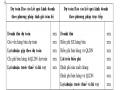
Business performance is determined by the difference between sales revenue, service provision and costs, expressed by the following formula:
Profit (loss) from business activities= | Revenue from sales and supplies service | - | Cost of goods sold | - | Selling expenses, administrative expenses business |
Maybe you are interested!
-
 Business Management Cost Accounting
 -
 Current Status of Cost Accounting and Business Management at Minh Vu Investment, Trade and Construction Joint Stock Company.
 -
 Current Status of Cost Accounting and Business Management at Huong Duong Tourism Development and Service Company Limited
 -
 Completing the organization of accounting for revenue, sales costs and determining business results at Hai Phong Paint Joint Stock Company - 1
 -
 Accounting for Revenue, Expenses and Business Results from a Management Accounting Perspective
Operating Revenue finance | - | Operating costs finance |
Results from other activities are determined as follows:
= | Other income | - | Other costs |
In general, accounting determines the business results of the company relatively simply. The data is entered from the beginning when the transaction occurs. The program automatically updates the corresponding accounts and books. At the end of the period, the program automatically generates summary reports and transfers the balances of the accounts in the correct order above.
User account
The company uses account 911 to determine business results. The company opens account 911. At the end of the period (month, quarter, year), the company determines the results.
Business results. Revenues are transferred to the credit side of account 911, expenses such as sales expenses, management expenses, financial expenses, other expenses, cost of goods sold, corporate income tax expenses are transferred to the debit side of account 911. (Appendix 2.1)
The balance on account 911 on the credit or debit side represents the profit (loss) in the business period. This balance is transferred to account 421 - Undistributed profits.
Accounting for business results.
Accounting account used: Account 911 "Determining business results".
The business results of 68 Minh Phu Construction Joint Stock Company include business results, financial results, and other results. Of which, business results are the main ones. The net profit from the company's business activities is determined by transferring all net revenue and cost of goods and services of all types of business activities together with selling expenses, administrative expenses, revenue and financial expenses, revenue and other operating expenses to account 911 to balance between total revenue and total expenses. Determining the business results at the Company complies with the matching principle, meaning that the recognition of revenue is consistent with the recognition of expenses. When recording a certain product's revenue, a corresponding expense is recorded, including input costs, sales expenses, and other expenses related to generating that revenue.
The company is using accounting software, at the end of each month, the accountant only needs to enter the month-end operation, the accounting software will automatically perform the accounting entries to transfer net sales revenue, cost of goods sold, financial revenue and other income, transfer financial expenses and other expenses, transfer corporate income tax expenses, transfer sales expenses, business management expenses, calculate and transfer the profit after corporate income tax of business activities in the period to