
- Regarding identifying sources of evidence and collecting evidence:
Circular 10/2012/TTLT-BCA-BQP-BTP-BTT&TT-VKSNDTC-TANDTC
dated September 10, 2012 of the Ministry of Public Security, Ministry of National Defense, Ministry of Justice, Ministry of Information and Communications, Supreme People's Procuracy, Supreme People's Court stipulates that "Electronic data is information contained in electronic media. Electronic data can be considered evidence". Thus, electronic data obtained on computer networks, the internet... is a source of evidence (electronic evidence). The provision that electronic evidence is evidence is consistent with the current situation of investigating and handling crimes using high technology.
According to the provisions of the 2015 Criminal Procedure Code, sources of evidence and electronic data are regulated in Articles 87, 88, 89 and 107 of the Criminal Procedure Code. In addition, Clause 3, Article 223 of the Criminal Procedure Code mentions the secret collection of electronic data as a special investigative measure. However, there is currently no sub-law document providing detailed guidance on this issue.
In addition, Article 107 of the Criminal Procedure Code also stipulates the contents of inspection, evaluation, preservation, and sealing of evidence as electronic data... However, electronic evidence has differences compared to other evidence as well as the detection, preservation, evaluation and use of this type of evidence is very difficult. When discovered, criminals can quickly delete or edit to destroy it, making it very difficult to collect and restore evidence. In addition, criminals often use nicknames and email addresses (email boxes) to communicate, and only after a long time the crime is discovered. At that time, recovering data in emails as well as identifying the person who created the email is very difficult. In many cases, data cannot be recovered and only based on statements for processing. Therefore, it is necessary to have a process for collecting, backing up, restoring, and encrypting data to ensure the integrity and maintain the value of evidence, and the responsibility of individuals collecting and preserving evidence.
Maybe you are interested!
-

 Requirements for Correct Application of Vietnamese Law on Mitigating Circumstances of Criminal Responsibility in Military Region 7
 -
 Car body electrical practice - 8
zt2i3t4l5ee
zt2a3gs
zt2a3ge
zc2o3n4t5e6n7ts
If the voltage is out of specification, replace the wire or connector.
If the voltage is within specification, install the front fog light relay and follow step 5.
Step 5 Check the front fog light switch
- Remove the D4 connector of the fog light switch
- Use a multimeter to measure the resistance of the front fog light switch.
Measurement location
Condition
Standard
D4-3 (BFG) -D4-4 (LFG)
Light switchFront Fog OFF
>10kΩ
D4-3 (BFG) -D4-4 (LFG)
Front fog light switchON
<1 Ω
- Standard resistor
D4 connector is located on the combination switch assembly.
If the resistance is out of specification, replace the combination switch (the fog light switch is located in the combination switch).
If the resistance is within specification, follow step 6.
Step 6 Check wiring and connectors (front fog light relay-light selector switch)
- Disconnect connector D4 of the combination switch assembly
- Use a voltmeter to measure the voltage value of jack D4 on the wire side.
Measurement location
Control modecontrol
Standard
D4-3 (BFG) - (-) AQ
TAIL
11 to 14 V
D4 connector for the wiring of the combination switch assembly
If the voltage does not meet the standard, replace the wire or connector.
If the voltage is within standard, there may have been an error in the previous measurements.
Step 7 Check the front fog lights
- Remove the front fog light electrical connector.
- Supply battery voltage to the fog lamp terminals
Jack 8, B9 of front fog lamp on the electrical side
blind first.
Power supply location
Terms and Conditions
Battery positive terminal - Terminal 2Battery negative terminal - Terminal 1
Fog lightsbefore morning
- If the light does not come on, replace the bulb.
If the light is on, re-plug the jack and continue to step 8.
Step 8 Check wiring and connectors (relay and front fog lights)
- Disconnect the B8 and B9 connectors of the front fog lights.
- Use a voltmeter to measure voltage at the following locations:
Measurement location
Switch location
Terms and Conditions
B8-2 - (-) AQ
Electric lock ON TAIL size switchFog switch ON
11 to 14 V
B9-2 - (-) AQ
Electric lock ONTAIL size switch Fog switch ON
11 to 14 V
B8 and B9 connectors on the front fog lamp wiring side
Voltage is not up to standard, repair or replace the jack. If up to standard, there may have been an error in the measurement process.
2.2.4. Procedure for removing, installing and adjusting fog lights 1. Procedure for removing
- Remove the front inner ear pads
Use a screwdriver to remove the 3 screws and remove the front part of the front inner ear liner
-Remove the fog light assembly
+ Disconnect the connector.
+ Use a screwdriver to remove 3 screws to remove the fog light cover
2. Installation sequence
-Rotate the fog lamp bulb in the direction indicated by the arrow as shown in the figure and remove the fog lamp from the fog lamp assembly.
-Rotate the fog light bulb in the direction indicated by the arrow as shown in the figure and install the light into the fog light assembly.
- Use a screwdriver to install the fog light cover
-Install the electrical connector
Attention: Be careful not to damage the plastic thread on the lamp assembly.
- Install the front inner ear pads
Use a screwdriver to install the front inner bumper with 3 screws.
3. Prepare the vehicle to adjust the fog light convergence. Prepare the vehicle:
- Make sure there is no damage or deformation to the vehicle body around the fog lights.
- Add fuel to the fuel tank
- Add oil to standard level.
- Add engine coolant to standard level.
- Inflate the tire to standard pressure.
- Place spare tire, tools and jack in original design position
- Do not leave any load in the luggage compartment.
- Let a person weighing about 75 kg sit in the driver's seat.
4. Prepare to check the fog light convergence
a/ Prepare the vehicle status as follows:
- Place the car in a dark enough place to see the lines. The lines are the dividing line, below which the light from the fog lights can be seen but above which it cannot.
- Place the car perpendicular to the wall.
- Keep a distance of 7.62 m between the center of the fog lamp and the wall.
- Park the car on level ground.
- Press the car down a few times to stabilize the suspension.
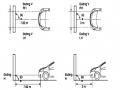
Note: A distance of approximately 7.62 m is required between the vehicle (fog lamp center) and the wall to adjust the convergence correctly. If the distance of 7.62 m cannot be achieved, set the correct distance of 3 m to check and adjust the fog lamp convergence. (Since the target area varies with the distance, please follow the instructions as shown in the figure.)
b/ Prepare a piece of thick white paper about 2 m high and 4 m wide to use as a screen.
c/ Draw a vertical line through the center of the screen (line V).
d/ Set the screen as shown in the picture. Note:
- Keep the screen perpendicular to the ground.
- Align the V line on the screen with the center of the vehicle.
e/Draw the reference lines (H, V LH and V RH lines) on the screen as shown in the figure.HINT:
Mark the center of the fog lamp on the screen. If the center mark cannot be seen on the fog lamp, use the center of the fog lamp or the manufacturer's name mark on the fog lamp as the center mark.
H line (fog light height):
Draw a line across the screen so that it passes through the center mark. Line H should be at the same height as the center mark of the fog light bulb.
Line V LH, V RH (center mark position of left fog lamp LH and right fog lamp RH):
Draw two lines so that they intersect line H at the center marks.
5. Check the fog light convergence
a/ Cover the fog lamp or remove the connector of the other side fog lamp to prevent light from the unchecked fog lamp from affecting the fog lamp convergence test.
b/ Start the engine.
c/ Turn on the fog lights and make sure that the dividing line is outside the standard area as shown in the drawing.
6. Adjust the fog light convergence
Use a screwdriver to adjust the fog light to the standard area by turning the toe adjustment screw.
Note: If the screw is adjusted too far, loosen it and then tighten it again, so that the last rotation of the light adjustment screw is clockwise.
3. Self-study questions
1. Describe the operating principle of the lighting system with automatic headlight function
2. Describe the operating principle of the lighting system with the function of rotating headlights when turning
3. Draw diagram and connect lighting system on Hyundai Porter car
4. Draw diagram and connect lighting system on Honda Accord 1992
5. Draw the lighting circuit on a 1993 Toyota Lexus
LESSON 3 MAINTENANCE AND REPAIR OF SIGNAL SYSTEM
I. IMPLEMENTATION GOAL
After completing this lesson, students will be able to:
- Distinguish between types of signals on cars
- Correctly describe common symptoms and suspected areas causing damage.
- Connecting signal circuits ensures technical requirements
- Disassemble, install, check, maintain and repair the signal system to ensure technical requirements.
- Ensure safety in work and industrial hygiene
II. LESSON CONTENT
1. General description
The signal system equipped on cars aims to create signals to notify other vehicles participating in traffic about the vehicle's operating status such as: stopping, parking, braking, reversing, turning...
Signals are used either by light such as headlamps, brake lights, turn signals….. or by sound such as horns, reverse music….
Just like the lighting system. A signal system circuit usually consists of: battery, fuse, wire, relay, electrical load and control switch. Only some switches of the signal system are on the combination switch. The switches of other signals are usually located in different locations such as in the gearbox or brake pedal……
2. Maintenance and repair
2.1. Turn signals and hazard lights
The installation location of the turn signal is shown in Figure 3.1. The turn signal control switch is located in the combination switch under the steering wheel. Turning this switch to the right or left will make the turn signal turn right or left.
The hazard light switch is used when the vehicle has a problem while participating in traffic. When the hazard light switch is turned on, all the turn signals on the vehicle will light up at a certain frequency. The hazard light switch is usually placed separately from the turn signal switch (some old cars integrate the hazard and turn signal switches on the same combination switch cluster).
Figure 3.1 Turn signal switch Figure 3.2 Hazard switch
The part that generates the flashing frequency for the lights is called a turn signal relay. The turn signal relay usually has 3 terminals: B (positive power supply); E (negative power supply); L (providing the turn signal switch to distribute to the
lamp)
2.1.1. Circuit diagram
To generate the frequency for the turn signal, a turn signal relay is used in the turn signal circuit. The current from the turn signal relay will be sent to the turn signal switch assembly to distribute the current to the turn signal lights for the driver's purpose.
Figure 3.3. Schematic diagram of a turn signal circuit without a hazard switch
1. Battery; 2. Electric lock; 3. Turn signal relay; 4. Turn signal switch; 5. Turn signal lamp; 6. Turn signal lamp; 7. Hazard switch
Figure 3.4 Schematic diagram of turn signal circuit with hazard switch
1. Battery; 2. Combination switch cluster; 3. Turn signal;
4. Turn signal light; 5. Turn signal relay
Today's cars no longer use three-pin turn signal relays (B, L, E) but use eight-pin turn signal relays (figure 3.5) (pin number 8 is used for hazard lights).
For this type, the current supplying the turn signal lights is supplied directly from the turn signal relay to the lights.
div.maincontent .p { color: black; font-family:"Times New Roman", serif; font-style: normal; font-weight: normal; text-decoration: none; font-size: 14pt; margin:0pt; } div.maincontent p { color: black; font-family:"Times New Roman", serif; font-style: normal; font-weight: normal; text-decoration: none; font-size: 14pt; margin:0pt; } div.maincontent .s1 { color: black; font-family:"Times New Roman", serif; font-style: normal; font-weight: normal; text-decoration: none; font-size: 13pt; } div.maincontent .s2 { color: black; font-family:"Times New Roman", serif; font-style: italic; font-weight: normal; text-decoration: none; font-size: 14pt; } div.maincontent .s3 { color: black; font-family:"Times New Roman", serif; font-style: normal; font-weight: normal; text-decoration: none; font-size: 14pt; } div.maincontent .s4 { color: black; font-family:"Times New Roman", serif; font-style: normal; font-weight: normal; text-decoration: none; font-size: 13pt; } div.maincontent .s5 { color: black; font-family:"Times New Roman", serif; font-style: normal; font-weight: normal; text-decoration: none; font-size: 13pt; vertical-align: 1pt; } div.maincontent .s6 { color: black; font-family:"Times New Roman", serif; font-style: normal; font-weight: normal; text-decoration: none; font-size: 11pt; } div.maincontent .s7 { color: black; font-family:"Times New Roman", serif; font-style: normal; font-weight: normal; text-decoration: none; font-size: 14pt; vertical-align: -9pt; } div.maincontent .s8 { color: black; font-family:"Times New Roman", serif; font-style: normal; font-weight: normal; text-decoration: none; font-size: 11pt; } div.maincontent .s9 { color: #008000; font-family:"Times New Roman", serif; font-style: normal; font-weight: normal; text-decoration: none; font-size: 14pt; } div.maincontent .s10 { color: black; font-family:"Times New Roman", serif; font-style: italic; font-weight: normal; te
Car body electrical practice - 8
zt2i3t4l5ee
zt2a3gs
zt2a3ge
zc2o3n4t5e6n7ts
If the voltage is out of specification, replace the wire or connector.
If the voltage is within specification, install the front fog light relay and follow step 5.
Step 5 Check the front fog light switch
- Remove the D4 connector of the fog light switch
- Use a multimeter to measure the resistance of the front fog light switch.
Measurement location
Condition
Standard
D4-3 (BFG) -D4-4 (LFG)
Light switchFront Fog OFF
>10kΩ
D4-3 (BFG) -D4-4 (LFG)
Front fog light switchON
<1 Ω
- Standard resistor
D4 connector is located on the combination switch assembly.
If the resistance is out of specification, replace the combination switch (the fog light switch is located in the combination switch).
If the resistance is within specification, follow step 6.
Step 6 Check wiring and connectors (front fog light relay-light selector switch)
- Disconnect connector D4 of the combination switch assembly
- Use a voltmeter to measure the voltage value of jack D4 on the wire side.
Measurement location
Control modecontrol
Standard
D4-3 (BFG) - (-) AQ
TAIL
11 to 14 V
D4 connector for the wiring of the combination switch assembly
If the voltage does not meet the standard, replace the wire or connector.
If the voltage is within standard, there may have been an error in the previous measurements.
Step 7 Check the front fog lights
- Remove the front fog light electrical connector.
- Supply battery voltage to the fog lamp terminals
Jack 8, B9 of front fog lamp on the electrical side
blind first.
Power supply location
Terms and Conditions
Battery positive terminal - Terminal 2Battery negative terminal - Terminal 1
Fog lightsbefore morning
- If the light does not come on, replace the bulb.
If the light is on, re-plug the jack and continue to step 8.
Step 8 Check wiring and connectors (relay and front fog lights)
- Disconnect the B8 and B9 connectors of the front fog lights.
- Use a voltmeter to measure voltage at the following locations:
Measurement location
Switch location
Terms and Conditions
B8-2 - (-) AQ
Electric lock ON TAIL size switchFog switch ON
11 to 14 V
B9-2 - (-) AQ
Electric lock ONTAIL size switch Fog switch ON
11 to 14 V
B8 and B9 connectors on the front fog lamp wiring side
Voltage is not up to standard, repair or replace the jack. If up to standard, there may have been an error in the measurement process.
2.2.4. Procedure for removing, installing and adjusting fog lights 1. Procedure for removing
- Remove the front inner ear pads
Use a screwdriver to remove the 3 screws and remove the front part of the front inner ear liner
-Remove the fog light assembly
+ Disconnect the connector.
+ Use a screwdriver to remove 3 screws to remove the fog light cover
2. Installation sequence
-Rotate the fog lamp bulb in the direction indicated by the arrow as shown in the figure and remove the fog lamp from the fog lamp assembly.
-Rotate the fog light bulb in the direction indicated by the arrow as shown in the figure and install the light into the fog light assembly.
- Use a screwdriver to install the fog light cover
-Install the electrical connector
Attention: Be careful not to damage the plastic thread on the lamp assembly.
- Install the front inner ear pads
Use a screwdriver to install the front inner bumper with 3 screws.
3. Prepare the vehicle to adjust the fog light convergence. Prepare the vehicle:
- Make sure there is no damage or deformation to the vehicle body around the fog lights.
- Add fuel to the fuel tank
- Add oil to standard level.
- Add engine coolant to standard level.
- Inflate the tire to standard pressure.
- Place spare tire, tools and jack in original design position
- Do not leave any load in the luggage compartment.
- Let a person weighing about 75 kg sit in the driver's seat.
4. Prepare to check the fog light convergence
a/ Prepare the vehicle status as follows:
- Place the car in a dark enough place to see the lines. The lines are the dividing line, below which the light from the fog lights can be seen but above which it cannot.
- Place the car perpendicular to the wall.
- Keep a distance of 7.62 m between the center of the fog lamp and the wall.
- Park the car on level ground.
- Press the car down a few times to stabilize the suspension.
Note: A distance of approximately 7.62 m is required between the vehicle (fog lamp center) and the wall to adjust the convergence correctly. If the distance of 7.62 m cannot be achieved, set the correct distance of 3 m to check and adjust the fog lamp convergence. (Since the target area varies with the distance, please follow the instructions as shown in the figure.)
b/ Prepare a piece of thick white paper about 2 m high and 4 m wide to use as a screen.
c/ Draw a vertical line through the center of the screen (line V).
d/ Set the screen as shown in the picture. Note:
- Keep the screen perpendicular to the ground.
- Align the V line on the screen with the center of the vehicle.
e/Draw the reference lines (H, V LH and V RH lines) on the screen as shown in the figure.HINT:
Mark the center of the fog lamp on the screen. If the center mark cannot be seen on the fog lamp, use the center of the fog lamp or the manufacturer's name mark on the fog lamp as the center mark.
H line (fog light height):
Draw a line across the screen so that it passes through the center mark. Line H should be at the same height as the center mark of the fog light bulb.
Line V LH, V RH (center mark position of left fog lamp LH and right fog lamp RH):
Draw two lines so that they intersect line H at the center marks.
5. Check the fog light convergence
a/ Cover the fog lamp or remove the connector of the other side fog lamp to prevent light from the unchecked fog lamp from affecting the fog lamp convergence test.
b/ Start the engine.
c/ Turn on the fog lights and make sure that the dividing line is outside the standard area as shown in the drawing.
6. Adjust the fog light convergence
Use a screwdriver to adjust the fog light to the standard area by turning the toe adjustment screw.
Note: If the screw is adjusted too far, loosen it and then tighten it again, so that the last rotation of the light adjustment screw is clockwise.
3. Self-study questions
1. Describe the operating principle of the lighting system with automatic headlight function
2. Describe the operating principle of the lighting system with the function of rotating headlights when turning
3. Draw diagram and connect lighting system on Hyundai Porter car
4. Draw diagram and connect lighting system on Honda Accord 1992
5. Draw the lighting circuit on a 1993 Toyota Lexus
LESSON 3 MAINTENANCE AND REPAIR OF SIGNAL SYSTEM
I. IMPLEMENTATION GOAL
After completing this lesson, students will be able to:
- Distinguish between types of signals on cars
- Correctly describe common symptoms and suspected areas causing damage.
- Connecting signal circuits ensures technical requirements
- Disassemble, install, check, maintain and repair the signal system to ensure technical requirements.
- Ensure safety in work and industrial hygiene
II. LESSON CONTENT
1. General description
The signal system equipped on cars aims to create signals to notify other vehicles participating in traffic about the vehicle's operating status such as: stopping, parking, braking, reversing, turning...
Signals are used either by light such as headlamps, brake lights, turn signals….. or by sound such as horns, reverse music….
Just like the lighting system. A signal system circuit usually consists of: battery, fuse, wire, relay, electrical load and control switch. Only some switches of the signal system are on the combination switch. The switches of other signals are usually located in different locations such as in the gearbox or brake pedal……
2. Maintenance and repair
2.1. Turn signals and hazard lights
The installation location of the turn signal is shown in Figure 3.1. The turn signal control switch is located in the combination switch under the steering wheel. Turning this switch to the right or left will make the turn signal turn right or left.
The hazard light switch is used when the vehicle has a problem while participating in traffic. When the hazard light switch is turned on, all the turn signals on the vehicle will light up at a certain frequency. The hazard light switch is usually placed separately from the turn signal switch (some old cars integrate the hazard and turn signal switches on the same combination switch cluster).
Figure 3.1 Turn signal switch Figure 3.2 Hazard switch
The part that generates the flashing frequency for the lights is called a turn signal relay. The turn signal relay usually has 3 terminals: B (positive power supply); E (negative power supply); L (providing the turn signal switch to distribute to the
lamp)
2.1.1. Circuit diagram
To generate the frequency for the turn signal, a turn signal relay is used in the turn signal circuit. The current from the turn signal relay will be sent to the turn signal switch assembly to distribute the current to the turn signal lights for the driver's purpose.
Figure 3.3. Schematic diagram of a turn signal circuit without a hazard switch
1. Battery; 2. Electric lock; 3. Turn signal relay; 4. Turn signal switch; 5. Turn signal lamp; 6. Turn signal lamp; 7. Hazard switch
Figure 3.4 Schematic diagram of turn signal circuit with hazard switch
1. Battery; 2. Combination switch cluster; 3. Turn signal;
4. Turn signal light; 5. Turn signal relay
Today's cars no longer use three-pin turn signal relays (B, L, E) but use eight-pin turn signal relays (figure 3.5) (pin number 8 is used for hazard lights).
For this type, the current supplying the turn signal lights is supplied directly from the turn signal relay to the lights.
div.maincontent .p { color: black; font-family:"Times New Roman", serif; font-style: normal; font-weight: normal; text-decoration: none; font-size: 14pt; margin:0pt; } div.maincontent p { color: black; font-family:"Times New Roman", serif; font-style: normal; font-weight: normal; text-decoration: none; font-size: 14pt; margin:0pt; } div.maincontent .s1 { color: black; font-family:"Times New Roman", serif; font-style: normal; font-weight: normal; text-decoration: none; font-size: 13pt; } div.maincontent .s2 { color: black; font-family:"Times New Roman", serif; font-style: italic; font-weight: normal; text-decoration: none; font-size: 14pt; } div.maincontent .s3 { color: black; font-family:"Times New Roman", serif; font-style: normal; font-weight: normal; text-decoration: none; font-size: 14pt; } div.maincontent .s4 { color: black; font-family:"Times New Roman", serif; font-style: normal; font-weight: normal; text-decoration: none; font-size: 13pt; } div.maincontent .s5 { color: black; font-family:"Times New Roman", serif; font-style: normal; font-weight: normal; text-decoration: none; font-size: 13pt; vertical-align: 1pt; } div.maincontent .s6 { color: black; font-family:"Times New Roman", serif; font-style: normal; font-weight: normal; text-decoration: none; font-size: 11pt; } div.maincontent .s7 { color: black; font-family:"Times New Roman", serif; font-style: normal; font-weight: normal; text-decoration: none; font-size: 14pt; vertical-align: -9pt; } div.maincontent .s8 { color: black; font-family:"Times New Roman", serif; font-style: normal; font-weight: normal; text-decoration: none; font-size: 11pt; } div.maincontent .s9 { color: #008000; font-family:"Times New Roman", serif; font-style: normal; font-weight: normal; text-decoration: none; font-size: 14pt; } div.maincontent .s10 { color: black; font-family:"Times New Roman", serif; font-style: italic; font-weight: normal; te -
 Practical Application of Criminal Procedure Law Regulations on the Rights of the Accused During the Prosecution and Investigation Stages From the Practice of Binh Duong Province
 -
 Building a Grassroots Party Organization in an Enterprise Must Ensure Correct Principles, Appropriateness to the Characteristics, Requirements, and Tasks of Each Enterprise
 -
 The system of defense counsel in the Criminal Procedure Law of Vietnam - Theory and practical application in Hai Duong province - 7
- Regarding identification of the victim:
Article 4 of Circular 10/2012/TTLT dated September 10, 2012 stipulates: “In the process of investigating criminal cases of crimes in the field of information technology and telecommunications, the prosecuting agencies must apply verification measures and take statements from victims according to the provisions of law. In case of objective reasons,
The victim cannot be identified (because the victim lives abroad; the specific victim cannot be identified or the full name and real address of the victim cannot be identified because the offender and the victim do not have direct contact with each other but only through the Internet or telecommunications network; the victim does not cooperate because they do not want to reveal their identity, the amount of damage is not much...), but based on the collected documents and evidence, there is a basis to determine that the suspect or defendant has committed a crime, then the failure to identify the victim or the failure to identify the full number of victims does not affect the determination of the nature of the case and the initiation of investigation, prosecution and trial is legally justified".
When applying Circular 10/2012, there are different perceptions and viewpoints among city-level prosecution agencies, as well as between superior and subordinate prosecution agencies.
A typical example is the case of "Using computer networks, telecommunications networks, and electronic means to commit acts of property appropriation" by Cletus Chimaobi Hillary and Okonkwo Mathias Ugochukwu. Chimaobi and Ugochukwu colluded with a number of subjects to hack into email addresses to obtain all information on the purchase and sale of goods between Hoa Sen Group Joint Stock Company (Vietnam) and KHP Roofing Company (Malaysia); between Sao Vang Rubber Joint Stock Company (Vietnam) and M/S Rashel Tyre House Company (Bangladesh), then forged requests for 02 foreign companies to pay for goods into designated accounts, appropriating 31,535 USD. During the investigation, 02 foreign companies refused to participate in the proceedings, so at the first instance trial, the People's Court of Ho Chi Minh City did not include the above 02 companies in the proceedings, and declared the confiscation of the amount to the state budget.
31,535 USD. However, the judgment was overturned by the appellate court because the Court of First Instance did not determine the legal status of the two companies and confiscated the amount of 31,535 USD, which was not in accordance with the law.
Thus, the awareness and viewpoints on identifying victims according to Circular 10/2012 among the prosecution agencies at two levels are not consistent.
In addition, the specific nature of crimes using computer networks, telecommunications networks, and electronic means to commit property appropriation has many victims.
During the investigation, the Investigation Agency verified, summoned, and published a newspaper search for them, but for some reason they did not come. However, when the case was brought to trial, the victims submitted a request to be considered for participation in the proceedings, leading to the case having to return the file for further investigation, causing a waste of time and prolongation.
- Regarding identifying the criminal:
This is a relatively difficult problem in crimes using computer networks, telecommunications networks, and electronic means to commit property appropriation in Ho Chi Minh City, because most of the subjects often use fake information, steal user information such as: stealing identity cards to open bank accounts for transactions. At the same time, criminals often use social networks such as Zalo, Facebook, Viber... to commit crimes, while some social networks have servers located abroad, managed by foreign agencies, so extracting data and encrypting information will encounter many difficulties in the investigation, prosecution, and trial of criminals.
- Regarding determining the amount of money appropriated and damage:
In some cases of using computer networks, telecommunications networks, and electronic means to commit property appropriation in Ho Chi Minh City, the subjects used the trick of creating websites or advertising on the Internet to sell cheap electronic products, installment payments, or other products that did not exist... to appropriate money to buy goods. Many victims transferred deposits and purchased goods, but when the Investigation Agency discovered the crime, their background could not be determined or the Investigation Agency could contact them but they did not cooperate and refused to make a statement. While the criminals all admitted that all the money in the accounts created by these subjects and defrauded buyers was fraudulent money, however, when the trial, the Court relied on the number of victims who filed complaints to determine the amount of money appropriated.
A typical case is: Phung Dinh Tan and his accomplices falsely advertised the sale of electronic goods on the website to lure customers to transfer money to buy goods into an account created by Tan in another person's name, in order to avoid responsibility. After transferring money, the victims did not receive the goods or received poor quality goods. The total amount of money transferred by the victims to the accounts was 706,065,7000 VND. Too
During the investigation, 14 people filed complaints about the appropriation of 259,800,000 VND. Tan and his accomplices admitted that all the money generated in the accounts created by Tan was fraudulent money, so the Ho Chi Minh City People's Procuracy prosecuted Tan and his accomplices for appropriating 706,065,700 VND. During the trial, the Ho Chi Minh City People's Court again based on the number of complainants and determined that Tan and his accomplices had appropriated 259,800,000 VND.
- Difficulties in handling criminals who are foreigners:
Recent trial practices in Ho Chi Minh City have shown that in a number of cases, subjects used computer networks, telecommunications networks, and electronic devices to commit organized property appropriation, in which the main criminals in the cases were foreigners residing abroad and colluding closely with domestic subjects to commit the crime. Therefore, during the investigation, prosecution, and trial, many difficulties were encountered in verifying background and applying legal regulations to foreigners.
A typical case is: Daniel Chiedozie Nwachukwu (Nigerian) committed a crime in Vietnam under the direction of a person calling himself White, who is living in Cambodia.
Daniel Chiedozie Nwachukwu only communicated with White via WhatsApp. Under White's direction, Daniel Chiedozie Nwachukwu met Vu Thi Ngoc Han for the first time and received 47,700 USD. Then, Daniel Chiedozie Nwachukwu delivered the above amount to another Nigerian compatriot (identity and background unknown) at Quynh Trang Hotel and was paid 200 USD. The second time, on October 12, 2017, Daniel Chiedozie Nwachukwu continued to meet Ms. Han to receive 1,200,000,000 VND and was discovered, recorded and arrested by the authorities.
Vu Thi Ngoc Han stated: around August 2017, through the social network Tango, Ms. Han met a person who claimed to be William Elvis David (David), an American citizen, working in Cambodia. David promised to marry her and asked Ms. Han to open an account at BIDV Bank to facilitate applying for a visa to the US later, so Han believed him and followed suit. By the end of September 2017, David asked Han to receive 48,450 USD transferred from Hong Kong and
delivered to Charles, David's friend currently in Vietnam. The first delivery was successful. On October 11, 2017, David continued to ask Ms. Han to receive 1,200,000,000 VND to deliver to Charles. On November 12, 2017, when Ms. Han was delivering money to Charles (exactly Daniel Chiedozie Nwachukwu), she was discovered by the authorities.
The People's Court of Ho Chi Minh City has declared the defendant Daniel Chiedozie Nwachukwu guilty of "The crime of using the Internet to commit property appropriation". However, it is not possible to identify the subject named White according to the testimony of Daniel Chiedozie Nwachukwu or William Elvis David according to the testimony of Vu Thi Ngoc Han (contacted via the social network Tango). This is one of the difficulties that the Ho Chi Minh City prosecution agency has encountered in the process of investigating, prosecuting and trying cases related to this crime.
- Difficulty in handling cases arising from virtual assets and money
virtual:
In the digital age, all commercial and consumer transactions
can all be done at home using devices connected to the Internet. Therefore, virtual assets, virtual currencies (cryptocurrencies, digital currencies) were born as a means of transaction with very high liquidity and very convenient to exchange, buy, sell and pay worldwide. Currently, the use of virtual currencies as a means of payment is not recognized and protected by Vietnamese law. However, a survey of the current situation in Ho Chi Minh City shows that although the legal framework is still rudimentary, virtual assets and virtual currencies are being traded widely, many people participate but mainly for speculative purposes, many organizations and individuals have set up virtual currency mining machines, and many scams related to virtual currencies have occurred in the area, causing disorder and insecurity in society. Therefore, although virtual currencies have great value, they are not currently considered protected assets by law, so the use of computer networks and the Internet to appropriate virtual currencies is not handled. This is a newly arising legal issue related to crimes using computer networks, telecommunications networks, and electronic means to commit acts of appropriating virtual currency assets. There needs to be specific legal corridors on this issue in the near future.
2.4.3. Causes of difficulties and problems
- Firstly, there is no document guiding the application of Article 290 of the Penal Code.
Currently, the Crime of using computer networks, telecommunications networks, and electronic means to commit acts of property appropriation (Article 290 of the Penal Code) has many points different from the provisions of Article 226b of the 1999 Penal Code, leading to inconsistent application of the provisions on this crime. These problems have been pointed out by the Thesis in the above sections through comments and evaluations of cases.
- Second, criminals are often people who are proficient in computer technology, have qualifications and experience in the field of information technology. This type of crime is mainly committed through social networks, the Internet... but most of the investigators, prosecutors, and judges in Ho Chi Minh City currently have certain limitations or do not meet the requirements for knowledge in the field of information technology, have not been trained, and have not been professionally trained to fight this type of crime, so they have difficulty in handling crimes.
- Third, Crimes using computer networks, telecommunications networks, and electronic means to commit acts of property appropriation are carried out with modern criminal tools and means, so the criminal methods are very sophisticated and difficult to detect, while equipment and technical means serving the work of detecting, investigating, and appraising this type of crime have not kept up with the rapid changes of modern technology.
- Fourth, the state management of information technology, telecommunications, e-commerce, computer networks, securities transactions, banking transactions, etc. in Ho Chi Minh City still reveals certain loopholes and shortcomings. In particular, the safety and security of many agencies, businesses and individuals are still lacking, many banks are often lenient in implementing policies on account opening procedures for individual customers, the inspection and approval process is still limited in principle, not ensuring quality and efficiency, customers only need an ID card to open a transaction card account.
- Fifth, the coordination relationship in the activities of examining and evaluating evidence of judicial agencies still has many shortcomings. For large and complicated cases in terms of criminal forms, most of the evidence in the fight against crime is often stored in computer data, so it is necessary to coordinate with specialized agencies in high technology in encoding data and converting data so that it can be read and viewed. However, the coordination relationship between agencies conducting proceedings in the city in the past has not been smooth and tight, which is also one of the causes of difficulties in the investigation, prosecution and trial of cases.
- Second, the issue of judicial assistance and judicial entrustment has very limited results, many judicial entrustment cases are prolonged or have no results. In many cases, the crime is committed on the territory of Vietnam, the offender is a foreigner and committed outside the territory of Vietnam, so investigation, handling, judicial entrustment and judicial assistance face many difficulties.
Chapter 2 Summary
In Chapter 2 of the thesis, the author has presented an overview of the crime situation using computer networks, telecommunications networks, and electronic means to commit acts of property appropriation in Ho Chi Minh City, thereby showing that this type of crime in the city tends to increase every year and with the nature, level, and scale of criminal activities becoming increasingly sophisticated, organized, and difficult to detect. At the same time, the author has also presented the practical application of the law in determining the crime according to Article 290 of the Penal Code through the analysis of typical cases, thereby seeing the shortcomings in the application of the law between the agencies conducting the proceedings at all levels in the area. In addition, the author of the thesis also surveyed, researched, studied, and presented the advantages, difficulties, and obstacles in the practical trial of crimes according to the provisions of Article 290 of the Penal Code and the causes leading to the shortcomings and limitations in the investigation, prosecution, and trial of this crime. This is an important basis for the author of the thesis to propose specific solutions to contribute to improving the effectiveness of law enforcement in the practice of trial of this crime in Ho Chi Minh City in the following years in chapter 3.
Chapter 3
REQUIREMENTS AND SOLUTIONS TO ENSURE PROPER APPLICATION OF CRIMINAL LAW ON CRIMES OF USING COMPUTER NETWORKS, TELECOMMUNICATIONS NETWORKS,
ELECTRONIC MEANS OF PROPERTY APPROPRIATION
3.1. Requirements to ensure correct application of criminal law on the crime of using computer networks, telecommunications networks, and electronic means to commit acts of property appropriation
Because this type of crime has a wide operating environment, a wide scope of impact, and huge consequences, the person assigned to conduct the proceedings must have a certain level of experience, skills, and qualifications. All procedural activities right from the initial investigation stage are meaningful and important, the results of these activities support and contribute to the procedural activities in the next stage, all procedural acts and activities always ensure the requirement of linking prosecution with investigation activities, inspection, and close supervision of trial activities. The results of the investigation activities must have a clear and specific purpose and meaning such as indictment or exoneration, avoiding rambling and lack of focus. Therefore, to ensure the correct application of criminal law on the crime of using computer networks, telecommunications networks, and electronic means to commit acts of property appropriation, the agencies conducting the proceedings must ensure the following requirements:
- In terms of investigation: Investigators need to correctly and objectively determine the actual circumstances of the case, based on the collection and verification of evidence and relevant documents to put forward appropriate hypotheses and draw accurate conclusions about the content of the case and the criminal acts of the accused. On that basis, choose the correct corresponding criminal law norms to accurately and fully compare the signs of constituting the crime prescribed in that norm with the circumstances of the acts performed in reality, on that basis, draw a well-founded conclusion about the consistency between the actual acts performed and the criminal acts prescribed in the article or clause of the corresponding law.