
Figure 1.1: Research process for topic 3
Figure 1.2: Research model on marketing-mix process (4Ps) 10
Figure 1.3: Service marketing mix model (7Ps) 11
Figure 1.4: Structure of marketing – mix 12
Maybe you are interested!
-

 Solution to Perfect Marketing-Mix Policy for Toeic and Ielts Training Services of Ames Hue International English Center
 -
 Perfecting Marketing Mix Planning
 -
 Analysis of factors affecting customer satisfaction with the quality of FiberVNN fiber optic internet service of Can Tho Telecom - 2
 -
 Other Marketing Mix Policies Supporting Promotional Policies 3.1. Product Policy
 -
 Some solutions to improve Marketing mix activities at Dat Xanh Mien Nam Investment and Service Joint Stock Company - 15
Figure 1.5: Typical distribution channels in the market 15
Figure 1.6: Elements of the Micro Marketing Environment 22
Figure 1.7: SWOT Matrix 26
Figure 1.8: Marketing-mix research model of FTTH service 30
Figure 2.1: Logo of FPT Telecommunication Joint Stock Company 36
Figure 2.2: The formation and development process of FPT Telecom 37
Figure 2.3: FPT Telecom Nam Song Huong Transaction Office 38
Figure 2.4: Organizational chart of FPT Telecom Hue 39
Figure 2.5: Spring opening banner on FPT website 59
Figure 2.6: Illustration of FPT's friend referral incentive program 59
Table 1.1: Sample composition scale table 31
Table 1.2: General rating scale 32
Table 2.1: Prices of Internet packages for households 42
Table 2.2: Price of Internet package combined with HD TV 42
Table 2.3: Internet package prices for businesses 42
Table 2.4: Human resource situation of FPT Hue branch in the period 2018 - 2020 43
Table 2.5: Business capital situation of FPT Hue branch 2018 - 2020 45
Table 2.6: Business performance results of FPT Hue branch in the period 2018 - 2020 45
Table 2.7: Number of fiber optic Internet subscribers in the period 2018 - 2020 50
Table 2.8: Proportion of FTTH customers by area in Hue City in 2020 51
Table 2.9: VNPT FTTH service prices 53
Table 2.10: Viettel FTTH service prices 54
Table 2.11: FTTH service prices of VTVcab 54
Table 2.12: Comparison of Internet service prices of 3 network operators: Viettel, VNPT and FPT 57
Table 2.13: Reliability test of product policy scale 66
Table 2.14: Reliability test of the Price Policy scale 68
Table 2.15: Reliability test of distribution policy scale 68
Table 2.16: Reliability test of promotion policy scale 69
Table 2.17: Reliability test of human policy scale 69
Table 2.18: Reliability test of general rating scale 70
Table 2.19: Customer evaluation of product policy 71
Table 2.20: Customer evaluation of pricing policy 72
Table 2.21: Customer evaluation of distribution policy 73
Table 2.22: Customer evaluation of promotion policy 74
Table 2.23: Customer evaluation of human resources policy 75
Table 2.24: Customer evaluation of general strategy 76
Table 2.25: Independent Samples T-test results on “Gender” 77
Table 2.26: Results of variance test by age 78
Table 2.27: Results of One Way ANOVA test by age 78
Table 2.28: Results of variance test by income 79
Table 2.29: Robust Test results by income 79
Table 3.1: SWOT matrix analysis of Hue 85 Telecommunication Joint Stock Company
LIST OF CHARTS
Chart 2.1: Gender structure 61
Chart 2.2: Age structure 62
Chart 2.3: Occupational structure 63
Chart 2.4: Structure of educational level 64
Chart 2.5: Income structure 64
Chart 2.6: Structure of time of use 65
Chart 2.7: Monthly usage package 66
PART I: PROBLEM STATEMENT
1. Reason for choosing the topic
In the context of the market economy with the current strong globalization trend, it has created conditions for telecommunications services, especially the Internet, to develop and play an important role in transmitting information for the development of the country. We can all find the necessary information right on the network or can transmit messages over the network in the shortest time. However, with the need to work and exchange large amounts of information, it requires a high speed Internet connection bandwidth. To meet that need, broadband services have been born with two groups of services: fixed broadband and mobile broadband. The most popular in the fixed broadband service group in Vietnam today is FTTH (Fiber-To-The-Home) fiber optic Internet - a broadband telecommunications network service using fiber optic cables connected to customers' homes to provide high-speed services such as telephone, high-speed Internet, IPTV, ...
Nowadays, customers have many choices and their needs are increasing. Accordingly, the trend of using FTTH fiber optic Internet to have a better network experience is becoming more and more popular. Therefore, the competition to dominate the Internet market between network operators is becoming increasingly fierce. In order to attract new customers and retain old customers, each network operator must have effective policies on pricing, customer care, technology or communication. To do that, in addition to determining the target market segment, it is necessary to focus on a successful marketing-mix strategy.
With the general situation that the telecommunications market is in a saturated phase, the current network operators are trying to find the best way for themselves. Grasping the increasing demand for network usage, telecommunications enterprises tend to focus on developing broadband Internet service packages, specifically FTTH services and FPT is no exception. FPT Telecom Joint Stock Company, Hue branch (FPT Telecom) started construction on November 12, 2009 in the Hue market. FPT Telecom has been striving every day to bring the most prestigious and quality products and services to customers, affirming its position in the market. However, with a potential market and many competitors like Hue city, FPT Telecom is also facing great competitive pressure. Therefore, the problem here is how FPT can compete with the big competitors out there or customers choose
choose to use the company's services instead of competitors. What business strategies does the company need to have and what marketing solutions are most effective? To solve that problem, I chose the topic: "Improving the marketing-mix policy for fiber optic Internet services at FPT Telecommunication Joint Stock Company, Hue branch".
2. Research objectives
2.1 General objectives
Based on the analysis and evaluation of the current status of marketing - mix activities for fiber optic Internet service packages, propose solutions to promote marketing - mix activities for fiber optic Internet service packages of FPT Telecommunication Joint Stock Company, Hue branch until 2025.
2.2 Specific objectives
Systematizing theory and practice of marketing-mix policy for telecommunication services.
Analyze and evaluate the current status of marketing-mix policies for fiber optic Internet services of FPT Telecommunication Joint Stock Company, Hue branch.
Proposing solutions to improve the marketing-mix policy for fiber optic Internet services of FPT Telecommunication Joint Stock Company, Hue branch until 2025.
3. Research object and scope
3.1 Research subjects
Research object: Theoretical and practical issues on marketing-mix and policies to improve marketing-mix activities for fiber optic Internet services of FPT Telecommunication Joint Stock Company, Hue branch.
Survey subjects: Customers who are using fiber optic Internet services at FPT Hue branch. This is a group of customers who have experienced the company's fiber optic Internet services, they will be more open in expressing their opinions and sending the most objective feedback to the company. In addition, due to time issues as well as the narrow research scale, this is the most suitable subject chosen to survey for the topic.
3.2 Scope of research
In terms of space
Focus on researching marketing-mix policies for fiber optic Internet services at FPT Telecommunication Joint Stock Company, Hue branch (46, Pham Hong Thai, Vinh Ward).
Ninh, Hue City), in Hue city and along the road from Huong Thuy town to the town
Lang Co, Hue City.
In terms of time
Analyze and evaluate the current situation over the 3 years 2018-2020, proposed solutions to be applied until 2025. Primary data was investigated in the period from February 20 to April 1, 2021.
4. Research methods
4.1 Research process
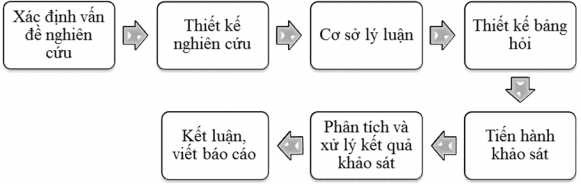
Figure 1.1: Research process
4.2 Data collection method
4.2.1 Secondary data collection methods
Available data and information are collected from reports of central and local agencies, from departments of FPT Telecom Hue Company. In addition, reference is also made through textbooks, books, newspapers, the Internet, etc.
Information about the company, history of establishment and development, capital situation, business performance report, labor situation, organizational chart, etc. were collected directly from departments: accounting department, business department, human resources department, or the company's website and fanpage during the internship period from 2018-2020.
4.2.2 Primary data collection methods
Quantitative research
The purpose of quantitative research is to draw conclusions about market research through collecting data from questionnaire surveys, using statistical and analytical methods to process data and figures.
Primary data was collected through questionnaire survey of customers.
using fiber optic Internet service at FPT Hue branch. The survey of these subjects
help to understand their assessment of marketing-mix policies for fiber optic Internet service (FTTH), thereby making it easier to come up with more complete solutions.
Questionnaire design
The questionnaire was developed based on the theoretical research in Chapter I/ Part II and adjusted based on the quantitative research results above. The questionnaire structure consists of 2 parts:
Part 1: Personal information.
Part 2: Main content of information that customers evaluate about Marketing-mix strategy for fiber optic Internet service at Telecommunication Joint Stock Company
FPT Hue branch.
All observed variables in the components of marketing activities use the 5-point Likert scale for evaluation because it provides more information than many other types of scales and is easy to set up. According to Dao Duy Tung (2019), the Likert scale (developed by Rensis Likert) is a very popular scale for summated rating scales including statements expressing the agreement or disagreement of a specific target unit, here the attitude of customers towards FPT's services and each answer is given a score reflecting 5 levels:
1. Strongly disagree
2. Disagree
3. Normal (Neutral)
4. Agree
5. Strongly agree
4.2.3 Sampling method
Sampling method: Because the company's customers include many different groups, customers are not concentrated in a certain location but are distributed in many different places, difficult to access, so the author uses a convenient random sampling method. During the survey, the focus is on customers who come to the company's service counter to pay monthly Internet service fees.
Sample size: The study determined the sample size using Cochran's formula (1977):
n =
In there:
n: Sample size
z: Threshold value of the normal distribution with significance level α = 5%; z = 1.96
p: Proportion of selected sample compared to the total e: Allowable sampling error


To ensure that the sample size is the largest and the estimate is safe, it  must be maximized. That is, it must take the value at which the partial derivative of is '=


2. Therefore, we choose the tense  . From that, we have:
n = = = 97 samples
According to Hoang Trong and Chu Nguyen Mong Ngoc (2008), the sample size used in factor analysis must be at least 5 times the number of quantitative variables needed to be analyzed for the survey results to be meaningful. Therefore, with 24 quantitative variables, the minimum sample size needed to investigate is 120 samples, however, to minimize risk, the author chose a sample size of 130 samples.
4.4.Data analysis and processing methods
4.4.1 For secondary data
Using descriptive statistics, comparison, tables, and data analysis methods to evaluate the implementation of marketing-mix policies for fiber optic Internet services (FTTH) of FPT Telecommunication Joint Stock Company, Hue branch.
4.4.2 For primary data
Research on primary data processing using SPSS 20 software according to the following process:
Encode the questionnaire on SPSS software.
Enter data on SPSS software and check the data again.
Conduct data processing and analysis.
To analyze customer evaluation of factors affecting marketing activities of FPT Telecommunication Joint Stock Company, Hue branch, the scales were tested through descriptive statistics, Cronbach's alpha reliability coefficient, Independent Sample T-Test, One Way ANOVA and One Sample T-test. Specifically:
Descriptive statistics method
Descriptive statistics method uses charts to evaluate the basic characteristics of the survey sample. Use descriptive statistics to study according to different indicators to show the characteristics of the survey sample in terms of gender, age, occupation, income, etc.
Method of testing scale reliability using Cronbach's alpha coefficient