
* National security projects
The total number of projects implemented with state budget capital in the period 2006 - 2010 of this sector is 5 projects with a total capital of 597 billion VND. Group A project is the resettlement project of TB1 shooting range with 1,230 households with an investment capital of nearly 600 billion VND. The results of implementation in the field are as follows: Putting into use 01 project in the provincial police headquarters with 2,000m2 of use, building 01 military training ground with an area of over 3,000m2; more than 500 households have been relocated out of the area to build TB1 shooting range with a capital of nearly 300 billion VND. These households have new accommodation to stabilize their lives. In addition, the project to support the construction of the provincial military command headquarters worth 20 billion VND has been completed with an area of over 1,000 m2, the project to upgrade the provincial police headquarters and military training grounds.
* Urban development projects
In the period of 2006 - 2010, there were 9 projects in the province with a total investment capital of 471 billion VND, accounting for 16.7% of the total investment capital. Of which, there were 03 group B projects with an investment capital of 391 billion VND, accounting for 83.01% of the total investment capital for the urban development sector. The main projects are: Bac Giang City Drainage Project with an investment capital of 300 billion VND, Thuong River 2-bank Infrastructure Project with an investment capital of 65 billion VND, Bac Giang City Central Park with an investment capital of 26 billion VND... The projects in the urban development sector were implemented up to 2010 and were in the unfinished stage and have not been promoted much. However, it has provided some results such as; meet 30% of households in clean water supply from new project, complete construction of 01 landfill, and road to landfill, as well as complete the city water supply expansion project.
2.3. Evaluation of the effectiveness of investment projects using state budget capital in Bac Giang province
Evaluating the investment efficiency of projects using state budget capital on a national scale and in a region or territory is a complicated issue. Especially in Bac Giang province, in recent years, there has been a lack of information on investment activities, so evaluating efficiency has also encountered many difficulties. In that condition, with the statistical data collected by the author, the initial evaluation of the efficiency of investment projects using state budget capital in Bac Giang province is as follows:
2.3.1. Achievements
2.3.1.1. Attracting investment from non-budgetary projects has increased sharply, mobilizing resources for economic development in the province.
With the capital from the provincial budget invested in the industrial park, it has gradually attracted a large number, rapidly growing in the number of projects as well as registered capital of investment projects from countries and regions around the world and large domestic corporations participating in investment in the province, specifically: During the whole period, it has attracted 66 foreign direct investment projects with registered capital of 613.5 million USD, bringing the total number of foreign direct investment projects to 93 projects, with registered capital of nearly 785 million USD. Attracted 318 domestic investment projects with a total registered capital of over 18,750 billion VND, 2 times higher than the period 2001 - 2005. At the same time, there are 17 ODA projects being implemented, with a total investment capital of 611 billion VND, 82 projects using foreign non-governmental aid (NGOs), with a committed value of 8.7 million USD. Many domestic investment projects and foreign direct investment projects after a period of investment have been put into effective operation, expanding production scale, investing in depth, the number of investment projects and registered investment capital of domestic and foreign organizations implemented in the period are shown in chart 2.4.
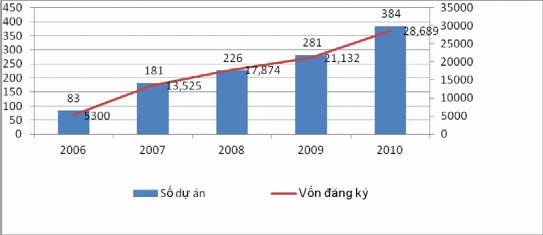
Chart 2.4: Number of projects and registered investment capital in Bac Giang province
Source: Department of Planning and Investment of Bac Giang province[57], [58], [59], [60], [61], [62]. Has attracted a number of large-scale projects with modern technology. Van Trung Industrial Park has a scale of 433ha, total investment of 733 million USD; has cleared land and handed over 208ha to Hong Hai Group, leveled over 70ha and is constructing technical infrastructure; FUHONG Company's project (Hong Hai) invested 100 million USD, has basically completed the construction of the factory and training center, and went into production in 2009. Son Dong Thermal Power Plant has put into operation unit 1, Yen Dung Thermal Power Plant; Quang Chau Industrial Park continues to level the land and invest in technical infrastructure, has granted an investment certificate to SANYO Group (Japan) with registered capital of 95 million USD, expected to employ 12 thousand workers.
moving
2.3.1.2. Some investment projects have had a positive impact contributing to environmental protection.
In Bac Giang province, projects funded by the State budget that have a positive impact on the environment are afforestation projects, typical projects are the project of planting 5 million hectares of new forests, waste treatment projects, water supply and drainage projects, etc. These projects are very important in preserving and protecting the ecological environment and natural environment. Due to limitations in data and the research locations of the sectors are very different, in this section, the thesis will choose a case study for the medical waste treatment project for evaluation.
The medical waste treatment project was implemented in the period (2005-2008). After more than 4 years of implementation, the total investment capital of the project is 1,006,763.00 EURO. Of which: The European Community funded: 745,004.62 EURO (74% of the total budget); local counterpart capital from the provincial government: 217,338.38 EURO (22% of the total budget), and non-governmental organizations funded: 44,420.00 EURO (4% of the total budget). The medical waste treatment project in Bac Giang province is funded by a small part of the state budget, the rest is non-refundable ODA capital from European community organizations and non-governmental organizations that do not have to be repaid. This project is very necessary in the province due to limited budget resources, while the demand for medical waste treatment of hospitals is high.
Hospitals in the area are increasingly urgent and necessary.
The project has organized the main activities including i) assessing the current situation of medical waste treatment in Bac Giang province; ii) Establishing a general plan for medical waste treatment, iii) Training and knowledge improvement program for management staff and employees on implementing medical waste treatment.
iv) Purchase and install necessary equipment for the safe collection, storage and treatment of medical waste; v) Implement the medical waste treatment plan. The results of this project have been to equip 12 modern medical waste incinerators and accompanying equipment for 12 hospitals in Bac Giang province, creating a scientific and effective medical waste management and treatment cycle, treating hundreds of tons of medical waste to meet national and international medical waste treatment standards. There have been significant impacts on the environment, specifically:
- The project has improved the environment and public health through the implementation of activities to improve medical waste management at 12 project sites. The project has provided training on medical waste management to the board of directors and staff of 12 hospitals, who will directly benefit from the training, improved occupational health and safety conditions, and a cleaner environment for patients, their families and the community.
- The project, by introducing appropriate methods and equipment for medical waste treatment, has raised awareness of the problems of hazardous waste affecting soil and groundwater, and the strong impact on humans through various types of infections such as zoonotic diseases. The occupational health and safety conditions of staff in 12 hospitals involved in medical waste treatment activities have been improved.
- The project has reduced the amount of toxic substances generated by outdated incinerators or open burning. Proper treatment of hospital wastewater before discharging into the urban drainage system will be given attention and will improve the quality.
health and environment of people living in Bac Giang city.
2.3.1.3. Impact of investment projects on increasing budget revenue
The state budget revenue in the period 2006-2010 had a fairly high growth rate, with an average rate of 27.2%. The specific budget revenue levels in the years during the period are as follows: In 2006, the budget revenue reached 628.3 billion VND, in 2007 it was 728.7 billion VND, in 2008 it was 836 billion VND, in 2009 it was 1,010 billion VND, in 2010 it was 1,730 billion VND. The contribution to this increase in budget revenue is mainly due to the investment of enterprises investing in industrial parks, enterprises of economic groups, domestic and foreign, investing in Bac Giang province. Some projects combining budget capital have created large revenue sources such as investment in industrial park projects, creating a platform for businesses to collect land tax in industrial parks, specifically, the land use fee collected from businesses in the area, mainly businesses located in industrial parks in 2010, was over 300 billion VND, accounting for the majority of the increase in budget revenue. In addition, some projects completed effectively and profitably have created a very large tax increase for the units benefiting from the project for the provincial budget.
2.3.1.4. Impact of investment projects on the technical infrastructure of the economy and the construction of socio-economic infrastructure, stabilizing people's lives
Project investment from the State budget capital is aimed at implementing investment in industries, fields, major economic programs of the State and social infrastructure fields and difficult areas that need investment from the State budget project to attract other components to invest. That is new investment, repair, replacement, restoration of fixed assets, technical improvement, innovation of technological processes, construction of new economic, technical and social infrastructure works with the ability to recover directly and indirectly. Investment projects from the State budget capital mainly only directly invest in infrastructure of fixed assets items, and
The capital investment is the additional fixed assets.
Table 2.6: Increased asset value in the period 2006-2010
Unit: billion VND
TT
Target (Calculated at actual price) | 2006 | 2007 | 2008 | 2009 | 2010 | |
1 | Total value of fixed assets increased in the province | 1,202 | 1,323 | 1,627 | 2,131 | 2,302 |
2 | Contribution of investment projects by State budget capital | 271 | 358 | 377 | 469 | 405 |
Ratio to total province | 23% | 27% | 23% | 22% | 18% | |
2.1 | Project implemented with provincial budget | 204 | 255 | 255 | 370 | 282 |
Ratio to total province | 17% | 19% | 16% | 17% | 12% | |
2.2 | Project implemented with NSTW capital | 67 | 103 | 122 | 99 | 124 |
Ratio to total of the whole province. | 6% | 8% | 7% | 5% | 5% |
Maybe you are interested!
-
 Management of investment projects using state budget capital in Ha Giang province - 2
 -
 The Impact of State Budget Investment Projects Has Not Been Much on Improving Product Competitiveness.
 -
 Perfecting Mechanisms and Policies for Construction Investment Projects from the State Budget in Vietnam's Transport Sector
 -
 Domestic Research on Project Investment Management Using State Budget Capital.
 -
 Preventing and Combating Violations of the Law in Basic Construction Investment with State Budget Capital Needs to Thoroughly Understand the Viewpoint of Mobilizing the Combined Strength of
Source: Bac Giang Provincial Statistics Office [19][20].
In general, over the past 5 years, investment projects using state budget capital have made important contributions to the enhancement of infrastructure for the economy with an average of 22.5% of the total annual increase in fixed assets of Bac Giang province, in which capital from the provincial state budget alone contributed 16.3%, 2.6 times higher than the increase in fixed assets created by the Central Budget project implemented in Bac Giang province (Table 2.6). Thanks to annual investment projects using state budget, some sectors in the province such as electricity, industry, and agriculture have made great strides, contributing significantly to the economic growth of Bac Giang province. In particular, after decades of development, the electricity sector in 2006 had only 73.5% of communes with grid electricity, but by 2010, all communes in the province had been provided with grid electricity.
As a result, machinery, equipment, and technical infrastructure are not only increased in quantity but also have higher technological level and production capacity. Infrastructure projects such as telecommunications, traffic works, and technology zones are extremely important as a premise for the development of other economic sectors. This is one of the important factors contributing to the promotion of
Strengthening production and business and enhancing the competitiveness of enterprises, enhancing the production capacity of the economy, contributing to the country's economic growth.
Projects on socio-economic infrastructure construction are of special importance, creating a fundamental premise to stabilize people's lives, creating positive conditions for production and business activities of all economic sectors. In the period of 2006-2010, investment activities of the project using the State budget have contributed significantly to the realization of this goal, which can be clearly seen in the investment in infrastructure construction, creating conditions for agricultural development, hunger eradication and poverty reduction, stabilizing people's lives, especially in rural areas. 79km of national and provincial highways have been upgraded and completed. Renovating 123km, hardening 500km of rural roads, 180km of canals and ditches, with a value of 265 billion VND, of which people contributed 131 billion VND, bringing the total length of hardened roads to date to 3,385km, accounting for 47.2% of rural roads, contributing to socio-economic development.
2.3.2. Limitations
2.3.2.1. The impact of investment projects using state budget capital is not much on economic growth.
Investment evaluation is shown by the coefficient of efficiency of investment capital for the whole society ICOR (Incremental Capital Output Ratio) is the percentage of investment capital spent to create a unit of % increase in GDP. This is an index that people often use in macroeconomic analysis to evaluate investment efficiency (the higher the ICOR index, the lower the efficiency). In developed countries, this index is usually around 3.5. The ICOR coefficient is related to the investment strategy and efficiency of using investment capital of a country. In developing countries, it is necessary to choose an investment strategy and a low ICOR coefficient, use appropriate technology combined with innovation, improve technology level, and invest reasonably in infrastructure. Too much investment in infrastructure construction will increase the ICOR coefficient, reducing the growth rate of the economy. With the investment capital compared to GDP always limited, investing in infrastructure construction beyond the capacity of the economy not only reduces investment in other areas that directly create growth but also leads to debt, causing loss of development in the long term [55]. In Vietnam, in the past two years
Recently, the ICOR coefficient has increased rapidly to above 7, seriously affecting the efficiency and growth rate under the condition of low investment level [66].
In fact, the annual change in the ICOR coefficient of Bac Giang province tends to correspond to the gradual increase in the economic growth rate in the province during this period. In the whole period of 2006-2010, the ICOR coefficient of the province is 6.6, lower than the national average. The ICOR coefficient at the above level is not appropriate because in 2006 and 2007, many new, large-scale investment projects were implemented. In 2005 and 2006, the projects were put into operation, causing the economy to have a high growth rate. In 2008, the economy reached 9.1%; in 2010, the economic growth rate reached 9.3%, but the ICOR of 2010 was 7.6. This result shows that the ICOR coefficient in Bac Giang province is increasing, proving that the increase in investment has not had a strong impact on economic growth in the province. On the other hand, to quantify the effectiveness of the project on the economy of Bac Giang province, we apply economic theory on basic input factors affecting GDP including:
C: Consumption; I: Investment;
G: Government spending EX: Export stream
U: Random error [25].
With the aim of examining the impact of investment capital of investment projects using state budget capital on GDP, we construct a simple functional relationship between GDP (Value of GDP in the period) and Von_NSNN (capital of investment projects using state budget capital in the period) as follows:
GDP= f(I)= e β1 Von_NSNN β2 e U (*) (2.1)
Taking the base log e on both sides of (*) we have the model:
Ln(GDPi)= β1+β2Ln(Von_NSNNi) +Ui (**) (2.2)
Analysis of Von_NSNN and GDP data (Table 4.10, Appendix 01) shows the coefficients (Skewness, Std.Error of Skewness, Kurtosis, Std.Error of Kurtosis)