
1.2.5 Factors to encourage and motivate employees:
Implement employee incentives according to Maslow's hierarchy of needs
A.Maslow's theory of needs is the pinnacle theory in identifying the natural needs of humans in general. Up to now, there has been no better alternative theory than this theory although there are many "candidates" intending to replace it. According to A.Maslow's theory, human natural needs are divided into different levels from "bottom" to "top", reflecting its "basic" level for the existence and development of humans as both a natural creature and a social entity.
In a business or organization, basic needs can be met through paying good and fair wages, providing free lunches or ensuring other benefits such as bonuses based on emulation titles, rewards for tours, travel, innovation rewards... To meet the need for safety, managers can ensure favorable working conditions, ensure stable work and fair treatment of employees. To ensure meeting the need for relationships, employees need to be given the opportunity to work in groups, given the opportunity to expand communication between departments, and encouraged to contribute ideas to serve the development of the business or organization. Also to meet the need for developing relationships, businesses or organizations need to have fun and entertainment activities on anniversaries or other holidays. To satisfy the need for respect, employees need to be respected for their personality and qualities. In addition to being paid a salary or having a satisfactory income according to market relations, they also want to be respected for their human values. Managers or leaders, therefore, need to have a mechanism and policy to praise, honor success and widely disseminate the results of individual achievements. At the same time, employees must also be provided with timely feedback and promoted to new positions with greater levels and scope of influence. For the need for self-improvement, managers or bosses need to provide opportunities to develop personal strengths. At the same time, employees need to be trained, developed, encouraged to participate in the improvement process in the enterprise or organization and given conditions for them to freely develop their careers. Large business corporations in the world "conquer" quite a lot of good employees, including very "difficult" employees from
Many different countries have a strong mechanism to attract this source of talent by creating conditions for them to have "houses, cars", stable jobs, very high salaries and strong promotion potential, including giving them important responsibilities and key leadership positions in the company.
Thus, to have the skills to encourage and motivate employees, managers need to research and understand the specific needs of their employees and have effective measures to meet them, meaning they need to know how to "indulge" employees in a reasonable and intentional way...
Currently in Vietnam, although the salaries paid are quite high in joint ventures, many people still want to work in state agencies with much lower salaries. The main reason comes from the notion that working in joint ventures is difficult to ensure advancement and social status development. This means that joint ventures with foreign countries are difficult to ensure advancement and social status development. ... Therefore, business owners or heads of organizations need to apply this theory of needs to discover the needs of each employee, forming appropriate employee motivation skills.
Applying Maslow's theory in human resource management:
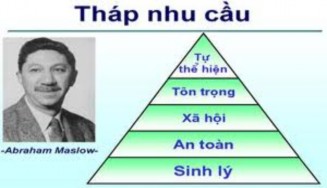
Figure 1.1: Maslow's hierarchy of needs
Source: http://kynangquanly.vn
In this theory, Maslow presents his philosophy of human resource management based on discovering and meeting 5 needs of workers:
Physiological needs Safety needs Social needs
Need for recognition Need for expression
So, if a manager wants his employees to work enthusiastically, work with all their heart, work productively, work effectively, be attached to the business, and be loyal to the manager, then that manager must know how to satisfy the above 5 needs of the employees.
* First : The physiological needs of workers include: Food + Clothing + Housing + Communication + Essential living + Provision. So to satisfy the physiological needs of workers, managers must create for workers a level of income sufficient to meet the minimum living standards as mentioned above.
According to Thanh Cong Website expert - Expert Nguyen Van Duc, the minimum living standard in the inner city districts of Hanoi in 2010 is: 1.2 million/month for food + 0.1 million/month for clothes + 0.5 million/month for rent + 0.1 million/month for communication (telephone, weddings, birthdays, vegetarian meals, etc.) + 0.3 million/month for essential living expenses (electricity, water, soap, toothpaste, etc.) + 0.3 million/month for reserve funds = 2.5 million/month.
When physiological needs are not met, workers will develop many bad habits such as: Stealing company time to work extra, finding ways to "pinch company money", and developing the mindset of "Standing on this mountain and looking at that mountain".
* Second : Workers' safety needs include 3 needs:
The first safety need is the need for “Health and life”, to satisfy this need for workers, managers must invest in labor protection equipment, create safe working conditions for workers. Only when workers feel that the working conditions of the enterprise ensure safety for health and life, then they will feel secure to work, feel secure to contribute to the enterprise.
- The second safety need is the need for security in terms of “Job and income”. To satisfy this need for workers, managers must ensure that workers have steady employment. Because only when employment is stable, workers can feel secure in their work and work well.
- The third safety need is the need for "Legal" safety. To satisfy this need for employees, managers must ensure that the tasks assigned to employees are carried out.
The work done is not illegal. And only when the workers know that what they do is not illegal can they be confident and determined to carry out that work to the end.
* Third : Social needs, social needs of workers include needs such as: the need to be cared for, cared for, encouraged, motivated, guided, trained, etc. by managers. Therefore, to satisfy these needs for workers, managers need to carry out the following activities:
- Visit and encourage employees when they are sick or their families have sad events.
- Managers must carry out congratulatory activities for employees when they have happy events such as birthdays or weddings.
- Managers must know how to encourage employees when they make mistakes at work, etc...
* Fourth : The need for recognition, in an organization, employees only want managers to recognize two things, which are to recognize “Those who do well” and “Those who do not do well”. This means that those who do well must be commended, rewarded, given raises, promoted, and promoted. Those who do not do well must be disciplined, have their bonuses and salaries deducted, be dismissed, or fired. Only then can fairness in the organization be ensured and employees feel secure enough to contribute to the organization.
* 5th : The need to express, during the working process, employees always want managers to create all conditions for them to develop in terms of professional qualifications, relationships in the organization and status. However, in reality, many managers are afraid that their employees are better than them, afraid that their employees will develop and advance faster than them, afraid that their employees will take their positions, so they find ways to restrain their employees' development. It is this way of thinking and doing that makes good employees not want to contribute, not want to work but find ways to move elsewhere.
Therefore, meeting the 5 needs of employees according to Maslow 's theory is a very important task. If managers can do that, it will definitely make employees work enthusiastically, work productively and stay with the business for a long time.
1.2.5.1 Remuneration factor:
COMPENSATION SYSTEM STRUCTURE
SALARY |
ALLOWANCE |
REWARD |
BENEFITS |
Maybe you are interested!
-
 Factors affecting brand value based on employees of Vietnamese commercial banks - 24
 -
 Factors affecting job satisfaction of employees of Joint Stock Commercial Bank for Foreign Trade of Vietnam in Ho Chi Minh City - 17
 -
 Analysis of factors affecting work motivation of employees at Thua Thien Hue Road Management and Construction Joint Stock Company - 16
 -
 Research Results on Factors Affecting Employees of Banks
 -
 Research Model of Factors Impacting Work Motivation of Tour Guide Team in Binh Dinh Province
ENEMY | |
LABOR | |
OBJECT | |
MATTER | |
ENEMY | |
LABOR | |
FLY | |
OBJECT | |
MATTER | |
Diagram 1.5: Structure of the remuneration system in enterprises
OPPORTUNITIES FOR PROMOTION |
INTERESTING WORK |
WORKING CONDITIONS |
Source: Associate Professor, Dr. Tran Kim Dung - year (2009) - human resource management. Statistical Publishing House (17th edition).
Forms of salary
- Time payment method:
Employees are paid according to working time: hour, day, week, month or year. Time wages are often widely used for some jobs of unskilled workers or jobs that are difficult to perform accurately and strictly or due to the nature of the job, if paid according to the product, the quality of the product will not be guaranteed, not bringing practical efficiency. Time wages paid to employees are often calculated on the basis of the amount of working time and the unit price of wages in a unit of time.
- Payment method per employee:
When employees with different skill levels perform the same type of work, the enterprise should pay employees according to the requirements and nature of the work they perform or according to the skill level of the employee. Enterprises that want to encourage employees to improve their skills and want to increase flexibility in the internal labor market so that they can move employees from one job to another often apply the employee-based payment method. Then, employees in the enterprise will be paid according to the skills they have.
They have been trained, educated and employed. Every time employees have additional educational certificates, or have evidence of improving the skills required for the job, they receive a salary increase. These businesses believe that the skills and knowledge that employees learn will stimulate increased labor productivity, promote innovation, and increase the value of the business.
- According to work results:
With the form of pay based on work results, employees are paid according to the results of their work. There are many forms of pay based on work results such as pay based on products, progressive products, group salary...
- By product:
This is a form of salary payment based on the unit price of salary for a product unit and the volume of products produced. This form of salary payment has linked the employee's income to the results of their work, has a strong incentive, brings high efficiency and is widely applied in enterprises. Employees will try to study, improve their skills, promote initiatives, improve techniques... Find all measures to improve labor productivity. In addition, paying wages by product also contributes to educating the consciousness of self-conscious, dynamic, positive labor in work and promoting the spirit of competition among employees in the enterprise. For different types of workers and civil servants, the form of salary by product has the following forms:
Pay wages based on individual direct products.
Pay by product with bonus or pay by progressive product.
Indirect piecework payment.
Pay by product when increasing labor norms
- According to standard time:
This method of payment is similar to the piece rate system, except that it uses a standard time factor prescribed for workers to perform a certain amount of work.
- Commission:
Commissions are commonly used to pay sales staff. Two types of commissions can be used:
Salary is calculated entirely as a percentage of sales.
Salary is calculated by monthly or daily time salary and percentage of monthly sales.
Commission percentages are calculated very differently in businesses, depending on the nature of the type of business item, the favorable location of the point of sale, the nature of competition in the market for the products sold... However, determining the commission rate is still not easy and difficult to be accurate.
- Paying group wages:
Usually applied to jobs that are of a synthetic nature, including many linked stages. The entire workload will be assigned to a group or a group of employees to perform. Salary will be paid to the group or team based on the final results of the group or team. This form stimulates all employees to care about the final product results of the group. In reality, this form of salary payment is often applied in assembly lines, in the construction industry, mechanical repair, in agriculture... To stimulate employees in the group to work actively.
- According to the business results of the enterprise:
This form is applied because employers want employees to understand the relationship between the remuneration for individuals, for their groups and the final production results of the enterprise. The incentive system by enterprise includes two types: Bonuses based on productivity and efficiency to closely link employee wages to specific productivity and efficiency factors such as saving time, materials, reducing costs... and profit sharing (to closely link employee wages to the enterprise's profits).
1.2.5.2 Bonus regime at the company:
By productivity, quality: Focuses on employee contributions to achieve specific production goals in a short time and is applied according to Scanlon's model, Rucker's model and time-saving model.
According to the profit sharing plan: In order to encourage employees to work well and pay attention to the business performance of the enterprise, many enterprises have applied the plan to share a part of the enterprise's profit with employees. Thus, in addition to monthly salary and bonus, employees are also shared a part of the enterprise's profit.
Employee Stock Option Plan: Has the same advantages as profit sharing plan. As employees and shareholders of the company, employees will be more interested in the business performance and strive to make the company grow stronger.
1.2.5.3 Other motivating factors:
Social insurance and health insurance regime:
- Social insurance: includes retirement, one-time social insurance, sickness, maternity, work accident
occupational diseases, death, voluntary social insurance...
- Health insurance: there are two types of health insurance, voluntary and compulsory. Create opportunities for advancement during work:
- Create a favorable working environment for employees to develop their talents.
- Help employees with all conditions so that they have the opportunity to advance when they work for the company.
Take care of stable accommodation for employees: create stable accommodation for employees at the company, especially those who live far away, those in difficult circumstances to help them overcome difficulties so they can focus their minds on work to effectively serve the company's operations.
1.2.6 Factors affecting human resource management:
Business environment factors:
- External business environment:
Impact on business operations, after carefully studying the external environment, the business will set out its mission and goals.
Economic context: Economic and business cycles greatly influence human resource management. During periods of economic recession or economic instability with a downward trend, it will directly affect the human resource policies of the enterprise. On the one hand, enterprises must maintain skilled labor, on the other hand, they must