
feelings. The results of the responses may not accurately reflect the perceptions of the research participants. To address this issue, the research team discussed and reached consensus on the research issue with the staff. This created a comfortable feeling for the research participants. On the other hand, the research participants did not have to fill out and sign the survey form.
The collection of information was mainly through a pre-designed and relatively long questionnaire, so there may be errors due to the cooperative attitude of the research participants. To overcome this problem, the investigators clearly explained the purpose and significance of the research, encouraging voluntary participation. The survey forms were checked by the investigators immediately after the participants completed filling out the questionnaire themselves to request additional information.
To avoid errors in data entry, we entered data using Epi Data software, and another person checked 10% of the entered questionnaires.
REFERENCES
Adomi Esharenana E. (2006). Job rotation in Nigerian university libraries. Library Review, 55 (1), 66-74. doi:doi:10.1108/00242530610641808
Allwood, J.M., & Lee, W.L. (2004). The Impact Of Job Rotation On Problem Solving Skills., Vol: 42, No: 5, 865-881. International Journal Of Production Research, 42 (5), 865-881.
Azizi, N., Zolfaghari, S., & Liang, M. (2010). Modeling job rotation in manufacturing systems: The study of employee's boredom and skill variations. International Journal of Production Economics, 123 (1), 69-85.
doi:https://doi.org/10.1016/j.ijpe.2009.07.010
Bennett B. (2003). Job rotation: Its role in promoting learning in organizations. Development and Learning in Organizations: An International Journal, 17 (4), 7- 9. doi:doi:10.1108/14777280310698386
Politburo. (2012). Conclusion of the Politburo on promoting the planning and rotation of leaders and managers until 2020 and the following years.
Buelens, M., & Van den Broeck, H. (2007). An analysis of differences in work motivation between public and private sector organizations. Public Administration Review, 67 (1), 65-74.
Campion, M.A., Cheraskin, L., & Stevens, M.J. (1994). Career Related Antecedents and Outcomes Of Job Rotation. The Academy Of Management Journal, 37 (6), 1518- 1552.
Coşgel, M.M., & Miceli, T.J. (1999). Job Rotation: Cost, Benefits, and Stylized Facts.
Journal Of Institutional and Theoretical Economics, 155 , 301-320.
Eguchi, K. (2005). Job Transfer And Influence Activities. Journal of Economic Behavior & Organization, 56 , 187-197.
Eriksson, T., & Ortega, J. (2006). The Adoption Of Job Rotation: Testing The Theories.
Industrial And Labor Relations Review, 59 (4), 653-667.
Friedrich, A., Kabst, R., Weber, W., & Rodehuth, M. (1998). Functional Flexibility: Merely Reacting or Acting Strategically? Employee Relations, 20 (5), 504-523.
Gallagher, W.E., & Einhorn, H.J. (1976). Motivation Theory and Job Design. The Journal Of Business, 49 (3), 358-373.
Gannon, M.J., & Brainin, U. (1971). Job Rotation And Employee Tenure Among Temporary Workers. The Academy Of Management Journal, 14 (1), 142-144.
Gannon, MJ, Poole, BA, & Prangley, RE (1972). Involuntary Job Rotation and Work Behavior. Personnel Journal .
Gomez, P.J., Lorente, J.J.C., & Cabrera, R.V. (2004). Training Practices And Organizational Learning Capability Relationships and Implications. Journal Of European Industrial Training, 28 (4), 234-256.
Ho, W.-H., Chang, C.S., Shih, Y.-L., & Liang, R.-D. (2009). Effects of job rotation and role stress among nurses on job satisfaction and organizational commitment. BMC Health Services Research, 9 , 8-8. doi:10.1186/1472-6963-9-8
Huang, H. J. (1999). Job Rotation From The Employees Point Of View. Human Resource Management Review, 7 (1), 75-85.
Jaturanonda, C., Nanthavanij, S., & Chongphaisal, P. (2006). A Survey Study On Weights Of Decision Criteria For Job Rotation In Thailand: Comparision Between Public and Private Sectors. The International Journal Of Human Resource Management, 17 (10), 1834-1851.
Jorgensen, M. (2005). Characteristics Of Job Rotation In The Midwest US Manufacturing Sector. Ergonomics, 48 (15), 1721-1733.
Karadimas, NV, & Papastamatiou, NP (2000). Tools For Job Rotation Integrating Access To Vocational Training. , Vol: 8 No: 2, 37-44. IJ Of Simulation, 8 (2), 37-44.
Kuijer, PPFM, Visser, B., & Kemper, HCG (1999). Job Rotation As A Factor Reducing Physical Workload At A Refuse Collecting Department. Ergonomics, 42 (4), 1167-1178.
Kurtuluş KAYMAZ. (2010). The Effects of Job Rotation Practices on Motivation: A Research on Managers in the Automotive Organizations. International Journal of Economics and Business Research .
Mann, G. (2006). A motive to serve: public service motivation in human resource management and the role of PSM in the nonprofit sector. Public Personnel Management, 35 (1), 33-48.
McShane, SL, & Steen, SL (2012). Canadian organizational behavior (8th ed.).
United States: McGraw-Hill Ryerson Limited.
Morris, J.R. (1956). Job Rotation. The Journal Of Business, 29 (4), 268-273. Mourdoukoutas, P., & Roy, U. (1994). Job Rotation and Public Policy: Theory With
Applications To Japan And The USA. International Journal Of Manpower, 15 (6),
57-71.
Ofner, A. (1987). Keeping Your High Achievers Motivated. Management Solutions, 32 (7), 35-39.
Ortega, J. (2001). Job Rotation As A Learning Mechanism. Management Science, 47 (10), 1361-1370.
Saravani, S. S., & Abbasi, B. (2013). Investigating the influence of job rotation on performance by considering skill variation and job satisfaction of bank employees. Technological Gazette, 20 (3), 473-478.
Ba Ria - Vung Tau Provincial Party Committee. (2016). Summary of planning and rotation of leaders and managers in the period 2011-2015 and orientations for the following years.
Umstot, DD, Mitchell, TR, & Bell, CH (1978). Goal Setting And Job Enrichment: An Integrated Approach To Job Design. The Academy Of Management Review, 3 (4), 867-879.
Weerd-NederHof, PC, Pacitti, PJ, Gomes, JFS, & Pearson, AW (2002). Tools For The Improvement Of Organizational Learning Processes In Innovation. Journal Of Workplace Learning, 14 (8), 320-331.
APPENDIX 1 SURVEY FORM
STAFF TRANSFER POLICY OF BA RIA - VUNG TAU PROVINCE
Maybe you are interested!
-
 Car body electrical practice - 8
zt2i3t4l5ee
zt2a3gs
zt2a3ge
zc2o3n4t5e6n7ts
If the voltage is out of specification, replace the wire or connector.
If the voltage is within specification, install the front fog light relay and follow step 5.
Step 5 Check the front fog light switch
- Remove the D4 connector of the fog light switch
- Use a multimeter to measure the resistance of the front fog light switch.
Measurement location
Condition
Standard
D4-3 (BFG) -D4-4 (LFG)
Light switchFront Fog OFF
>10kΩ
D4-3 (BFG) -D4-4 (LFG)
Front fog light switchON
<1 Ω
- Standard resistor
D4 connector is located on the combination switch assembly.
If the resistance is out of specification, replace the combination switch (the fog light switch is located in the combination switch).
If the resistance is within specification, follow step 6.
Step 6 Check wiring and connectors (front fog light relay-light selector switch)
- Disconnect connector D4 of the combination switch assembly
- Use a voltmeter to measure the voltage value of jack D4 on the wire side.
Measurement location
Control modecontrol
Standard
D4-3 (BFG) - (-) AQ
TAIL
11 to 14 V
D4 connector for the wiring of the combination switch assembly
If the voltage does not meet the standard, replace the wire or connector.
If the voltage is within standard, there may have been an error in the previous measurements.
Step 7 Check the front fog lights
- Remove the front fog light electrical connector.
- Supply battery voltage to the fog lamp terminals
Jack 8, B9 of front fog lamp on the electrical side
blind first.
Power supply location
Terms and Conditions
Battery positive terminal - Terminal 2Battery negative terminal - Terminal 1
Fog lightsbefore morning
- If the light does not come on, replace the bulb.
If the light is on, re-plug the jack and continue to step 8.
Step 8 Check wiring and connectors (relay and front fog lights)
- Disconnect the B8 and B9 connectors of the front fog lights.
- Use a voltmeter to measure voltage at the following locations:
Measurement location
Switch location
Terms and Conditions
B8-2 - (-) AQ
Electric lock ON TAIL size switchFog switch ON
11 to 14 V
B9-2 - (-) AQ
Electric lock ONTAIL size switch Fog switch ON
11 to 14 V
B8 and B9 connectors on the front fog lamp wiring side
Voltage is not up to standard, repair or replace the jack. If up to standard, there may have been an error in the measurement process.
2.2.4. Procedure for removing, installing and adjusting fog lights 1. Procedure for removing
- Remove the front inner ear pads
Use a screwdriver to remove the 3 screws and remove the front part of the front inner ear liner
-Remove the fog light assembly
+ Disconnect the connector.
+ Use a screwdriver to remove 3 screws to remove the fog light cover
2. Installation sequence
-Rotate the fog lamp bulb in the direction indicated by the arrow as shown in the figure and remove the fog lamp from the fog lamp assembly.
-Rotate the fog light bulb in the direction indicated by the arrow as shown in the figure and install the light into the fog light assembly.
- Use a screwdriver to install the fog light cover
-Install the electrical connector
Attention: Be careful not to damage the plastic thread on the lamp assembly.
- Install the front inner ear pads
Use a screwdriver to install the front inner bumper with 3 screws.
3. Prepare the vehicle to adjust the fog light convergence. Prepare the vehicle:
- Make sure there is no damage or deformation to the vehicle body around the fog lights.
- Add fuel to the fuel tank
- Add oil to standard level.
- Add engine coolant to standard level.
- Inflate the tire to standard pressure.
- Place spare tire, tools and jack in original design position
- Do not leave any load in the luggage compartment.
- Let a person weighing about 75 kg sit in the driver's seat.
4. Prepare to check the fog light convergence
a/ Prepare the vehicle status as follows:
- Place the car in a dark enough place to see the lines. The lines are the dividing line, below which the light from the fog lights can be seen but above which it cannot.
- Place the car perpendicular to the wall.
- Keep a distance of 7.62 m between the center of the fog lamp and the wall.
- Park the car on level ground.
- Press the car down a few times to stabilize the suspension.
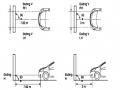
Note: A distance of approximately 7.62 m is required between the vehicle (fog lamp center) and the wall to adjust the convergence correctly. If the distance of 7.62 m cannot be achieved, set the correct distance of 3 m to check and adjust the fog lamp convergence. (Since the target area varies with the distance, please follow the instructions as shown in the figure.)
b/ Prepare a piece of thick white paper about 2 m high and 4 m wide to use as a screen.
c/ Draw a vertical line through the center of the screen (line V).
d/ Set the screen as shown in the picture. Note:
- Keep the screen perpendicular to the ground.
- Align the V line on the screen with the center of the vehicle.
e/Draw the reference lines (H, V LH and V RH lines) on the screen as shown in the figure.HINT:
Mark the center of the fog lamp on the screen. If the center mark cannot be seen on the fog lamp, use the center of the fog lamp or the manufacturer's name mark on the fog lamp as the center mark.
H line (fog light height):
Draw a line across the screen so that it passes through the center mark. Line H should be at the same height as the center mark of the fog light bulb.
Line V LH, V RH (center mark position of left fog lamp LH and right fog lamp RH):
Draw two lines so that they intersect line H at the center marks.
5. Check the fog light convergence
a/ Cover the fog lamp or remove the connector of the other side fog lamp to prevent light from the unchecked fog lamp from affecting the fog lamp convergence test.
b/ Start the engine.
c/ Turn on the fog lights and make sure that the dividing line is outside the standard area as shown in the drawing.
6. Adjust the fog light convergence
Use a screwdriver to adjust the fog light to the standard area by turning the toe adjustment screw.
Note: If the screw is adjusted too far, loosen it and then tighten it again, so that the last rotation of the light adjustment screw is clockwise.
3. Self-study questions
1. Describe the operating principle of the lighting system with automatic headlight function
2. Describe the operating principle of the lighting system with the function of rotating headlights when turning
3. Draw diagram and connect lighting system on Hyundai Porter car
4. Draw diagram and connect lighting system on Honda Accord 1992
5. Draw the lighting circuit on a 1993 Toyota Lexus
LESSON 3 MAINTENANCE AND REPAIR OF SIGNAL SYSTEM
I. IMPLEMENTATION GOAL
After completing this lesson, students will be able to:
- Distinguish between types of signals on cars
- Correctly describe common symptoms and suspected areas causing damage.
- Connecting signal circuits ensures technical requirements
- Disassemble, install, check, maintain and repair the signal system to ensure technical requirements.
- Ensure safety in work and industrial hygiene
II. LESSON CONTENT
1. General description
The signal system equipped on cars aims to create signals to notify other vehicles participating in traffic about the vehicle's operating status such as: stopping, parking, braking, reversing, turning...
Signals are used either by light such as headlamps, brake lights, turn signals….. or by sound such as horns, reverse music….
Just like the lighting system. A signal system circuit usually consists of: battery, fuse, wire, relay, electrical load and control switch. Only some switches of the signal system are on the combination switch. The switches of other signals are usually located in different locations such as in the gearbox or brake pedal……
2. Maintenance and repair
2.1. Turn signals and hazard lights
The installation location of the turn signal is shown in Figure 3.1. The turn signal control switch is located in the combination switch under the steering wheel. Turning this switch to the right or left will make the turn signal turn right or left.
The hazard light switch is used when the vehicle has a problem while participating in traffic. When the hazard light switch is turned on, all the turn signals on the vehicle will light up at a certain frequency. The hazard light switch is usually placed separately from the turn signal switch (some old cars integrate the hazard and turn signal switches on the same combination switch cluster).
Figure 3.1 Turn signal switch Figure 3.2 Hazard switch
The part that generates the flashing frequency for the lights is called a turn signal relay. The turn signal relay usually has 3 terminals: B (positive power supply); E (negative power supply); L (providing the turn signal switch to distribute to the
lamp)
2.1.1. Circuit diagram
To generate the frequency for the turn signal, a turn signal relay is used in the turn signal circuit. The current from the turn signal relay will be sent to the turn signal switch assembly to distribute the current to the turn signal lights for the driver's purpose.
Figure 3.3. Schematic diagram of a turn signal circuit without a hazard switch
1. Battery; 2. Electric lock; 3. Turn signal relay; 4. Turn signal switch; 5. Turn signal lamp; 6. Turn signal lamp; 7. Hazard switch
Figure 3.4 Schematic diagram of turn signal circuit with hazard switch
1. Battery; 2. Combination switch cluster; 3. Turn signal;
4. Turn signal light; 5. Turn signal relay
Today's cars no longer use three-pin turn signal relays (B, L, E) but use eight-pin turn signal relays (figure 3.5) (pin number 8 is used for hazard lights).
For this type, the current supplying the turn signal lights is supplied directly from the turn signal relay to the lights.
div.maincontent .p { color: black; font-family:"Times New Roman", serif; font-style: normal; font-weight: normal; text-decoration: none; font-size: 14pt; margin:0pt; } div.maincontent p { color: black; font-family:"Times New Roman", serif; font-style: normal; font-weight: normal; text-decoration: none; font-size: 14pt; margin:0pt; } div.maincontent .s1 { color: black; font-family:"Times New Roman", serif; font-style: normal; font-weight: normal; text-decoration: none; font-size: 13pt; } div.maincontent .s2 { color: black; font-family:"Times New Roman", serif; font-style: italic; font-weight: normal; text-decoration: none; font-size: 14pt; } div.maincontent .s3 { color: black; font-family:"Times New Roman", serif; font-style: normal; font-weight: normal; text-decoration: none; font-size: 14pt; } div.maincontent .s4 { color: black; font-family:"Times New Roman", serif; font-style: normal; font-weight: normal; text-decoration: none; font-size: 13pt; } div.maincontent .s5 { color: black; font-family:"Times New Roman", serif; font-style: normal; font-weight: normal; text-decoration: none; font-size: 13pt; vertical-align: 1pt; } div.maincontent .s6 { color: black; font-family:"Times New Roman", serif; font-style: normal; font-weight: normal; text-decoration: none; font-size: 11pt; } div.maincontent .s7 { color: black; font-family:"Times New Roman", serif; font-style: normal; font-weight: normal; text-decoration: none; font-size: 14pt; vertical-align: -9pt; } div.maincontent .s8 { color: black; font-family:"Times New Roman", serif; font-style: normal; font-weight: normal; text-decoration: none; font-size: 11pt; } div.maincontent .s9 { color: #008000; font-family:"Times New Roman", serif; font-style: normal; font-weight: normal; text-decoration: none; font-size: 14pt; } div.maincontent .s10 { color: black; font-family:"Times New Roman", serif; font-style: italic; font-weight: normal; te
Car body electrical practice - 8
zt2i3t4l5ee
zt2a3gs
zt2a3ge
zc2o3n4t5e6n7ts
If the voltage is out of specification, replace the wire or connector.
If the voltage is within specification, install the front fog light relay and follow step 5.
Step 5 Check the front fog light switch
- Remove the D4 connector of the fog light switch
- Use a multimeter to measure the resistance of the front fog light switch.
Measurement location
Condition
Standard
D4-3 (BFG) -D4-4 (LFG)
Light switchFront Fog OFF
>10kΩ
D4-3 (BFG) -D4-4 (LFG)
Front fog light switchON
<1 Ω
- Standard resistor
D4 connector is located on the combination switch assembly.
If the resistance is out of specification, replace the combination switch (the fog light switch is located in the combination switch).
If the resistance is within specification, follow step 6.
Step 6 Check wiring and connectors (front fog light relay-light selector switch)
- Disconnect connector D4 of the combination switch assembly
- Use a voltmeter to measure the voltage value of jack D4 on the wire side.
Measurement location
Control modecontrol
Standard
D4-3 (BFG) - (-) AQ
TAIL
11 to 14 V
D4 connector for the wiring of the combination switch assembly
If the voltage does not meet the standard, replace the wire or connector.
If the voltage is within standard, there may have been an error in the previous measurements.
Step 7 Check the front fog lights
- Remove the front fog light electrical connector.
- Supply battery voltage to the fog lamp terminals
Jack 8, B9 of front fog lamp on the electrical side
blind first.
Power supply location
Terms and Conditions
Battery positive terminal - Terminal 2Battery negative terminal - Terminal 1
Fog lightsbefore morning
- If the light does not come on, replace the bulb.
If the light is on, re-plug the jack and continue to step 8.
Step 8 Check wiring and connectors (relay and front fog lights)
- Disconnect the B8 and B9 connectors of the front fog lights.
- Use a voltmeter to measure voltage at the following locations:
Measurement location
Switch location
Terms and Conditions
B8-2 - (-) AQ
Electric lock ON TAIL size switchFog switch ON
11 to 14 V
B9-2 - (-) AQ
Electric lock ONTAIL size switch Fog switch ON
11 to 14 V
B8 and B9 connectors on the front fog lamp wiring side
Voltage is not up to standard, repair or replace the jack. If up to standard, there may have been an error in the measurement process.
2.2.4. Procedure for removing, installing and adjusting fog lights 1. Procedure for removing
- Remove the front inner ear pads
Use a screwdriver to remove the 3 screws and remove the front part of the front inner ear liner
-Remove the fog light assembly
+ Disconnect the connector.
+ Use a screwdriver to remove 3 screws to remove the fog light cover
2. Installation sequence
-Rotate the fog lamp bulb in the direction indicated by the arrow as shown in the figure and remove the fog lamp from the fog lamp assembly.
-Rotate the fog light bulb in the direction indicated by the arrow as shown in the figure and install the light into the fog light assembly.
- Use a screwdriver to install the fog light cover
-Install the electrical connector
Attention: Be careful not to damage the plastic thread on the lamp assembly.
- Install the front inner ear pads
Use a screwdriver to install the front inner bumper with 3 screws.
3. Prepare the vehicle to adjust the fog light convergence. Prepare the vehicle:
- Make sure there is no damage or deformation to the vehicle body around the fog lights.
- Add fuel to the fuel tank
- Add oil to standard level.
- Add engine coolant to standard level.
- Inflate the tire to standard pressure.
- Place spare tire, tools and jack in original design position
- Do not leave any load in the luggage compartment.
- Let a person weighing about 75 kg sit in the driver's seat.
4. Prepare to check the fog light convergence
a/ Prepare the vehicle status as follows:
- Place the car in a dark enough place to see the lines. The lines are the dividing line, below which the light from the fog lights can be seen but above which it cannot.
- Place the car perpendicular to the wall.
- Keep a distance of 7.62 m between the center of the fog lamp and the wall.
- Park the car on level ground.
- Press the car down a few times to stabilize the suspension.
Note: A distance of approximately 7.62 m is required between the vehicle (fog lamp center) and the wall to adjust the convergence correctly. If the distance of 7.62 m cannot be achieved, set the correct distance of 3 m to check and adjust the fog lamp convergence. (Since the target area varies with the distance, please follow the instructions as shown in the figure.)
b/ Prepare a piece of thick white paper about 2 m high and 4 m wide to use as a screen.
c/ Draw a vertical line through the center of the screen (line V).
d/ Set the screen as shown in the picture. Note:
- Keep the screen perpendicular to the ground.
- Align the V line on the screen with the center of the vehicle.
e/Draw the reference lines (H, V LH and V RH lines) on the screen as shown in the figure.HINT:
Mark the center of the fog lamp on the screen. If the center mark cannot be seen on the fog lamp, use the center of the fog lamp or the manufacturer's name mark on the fog lamp as the center mark.
H line (fog light height):
Draw a line across the screen so that it passes through the center mark. Line H should be at the same height as the center mark of the fog light bulb.
Line V LH, V RH (center mark position of left fog lamp LH and right fog lamp RH):
Draw two lines so that they intersect line H at the center marks.
5. Check the fog light convergence
a/ Cover the fog lamp or remove the connector of the other side fog lamp to prevent light from the unchecked fog lamp from affecting the fog lamp convergence test.
b/ Start the engine.
c/ Turn on the fog lights and make sure that the dividing line is outside the standard area as shown in the drawing.
6. Adjust the fog light convergence
Use a screwdriver to adjust the fog light to the standard area by turning the toe adjustment screw.
Note: If the screw is adjusted too far, loosen it and then tighten it again, so that the last rotation of the light adjustment screw is clockwise.
3. Self-study questions
1. Describe the operating principle of the lighting system with automatic headlight function
2. Describe the operating principle of the lighting system with the function of rotating headlights when turning
3. Draw diagram and connect lighting system on Hyundai Porter car
4. Draw diagram and connect lighting system on Honda Accord 1992
5. Draw the lighting circuit on a 1993 Toyota Lexus
LESSON 3 MAINTENANCE AND REPAIR OF SIGNAL SYSTEM
I. IMPLEMENTATION GOAL
After completing this lesson, students will be able to:
- Distinguish between types of signals on cars
- Correctly describe common symptoms and suspected areas causing damage.
- Connecting signal circuits ensures technical requirements
- Disassemble, install, check, maintain and repair the signal system to ensure technical requirements.
- Ensure safety in work and industrial hygiene
II. LESSON CONTENT
1. General description
The signal system equipped on cars aims to create signals to notify other vehicles participating in traffic about the vehicle's operating status such as: stopping, parking, braking, reversing, turning...
Signals are used either by light such as headlamps, brake lights, turn signals….. or by sound such as horns, reverse music….
Just like the lighting system. A signal system circuit usually consists of: battery, fuse, wire, relay, electrical load and control switch. Only some switches of the signal system are on the combination switch. The switches of other signals are usually located in different locations such as in the gearbox or brake pedal……
2. Maintenance and repair
2.1. Turn signals and hazard lights
The installation location of the turn signal is shown in Figure 3.1. The turn signal control switch is located in the combination switch under the steering wheel. Turning this switch to the right or left will make the turn signal turn right or left.
The hazard light switch is used when the vehicle has a problem while participating in traffic. When the hazard light switch is turned on, all the turn signals on the vehicle will light up at a certain frequency. The hazard light switch is usually placed separately from the turn signal switch (some old cars integrate the hazard and turn signal switches on the same combination switch cluster).
Figure 3.1 Turn signal switch Figure 3.2 Hazard switch
The part that generates the flashing frequency for the lights is called a turn signal relay. The turn signal relay usually has 3 terminals: B (positive power supply); E (negative power supply); L (providing the turn signal switch to distribute to the
lamp)
2.1.1. Circuit diagram
To generate the frequency for the turn signal, a turn signal relay is used in the turn signal circuit. The current from the turn signal relay will be sent to the turn signal switch assembly to distribute the current to the turn signal lights for the driver's purpose.
Figure 3.3. Schematic diagram of a turn signal circuit without a hazard switch
1. Battery; 2. Electric lock; 3. Turn signal relay; 4. Turn signal switch; 5. Turn signal lamp; 6. Turn signal lamp; 7. Hazard switch
Figure 3.4 Schematic diagram of turn signal circuit with hazard switch
1. Battery; 2. Combination switch cluster; 3. Turn signal;
4. Turn signal light; 5. Turn signal relay
Today's cars no longer use three-pin turn signal relays (B, L, E) but use eight-pin turn signal relays (figure 3.5) (pin number 8 is used for hazard lights).
For this type, the current supplying the turn signal lights is supplied directly from the turn signal relay to the lights.
div.maincontent .p { color: black; font-family:"Times New Roman", serif; font-style: normal; font-weight: normal; text-decoration: none; font-size: 14pt; margin:0pt; } div.maincontent p { color: black; font-family:"Times New Roman", serif; font-style: normal; font-weight: normal; text-decoration: none; font-size: 14pt; margin:0pt; } div.maincontent .s1 { color: black; font-family:"Times New Roman", serif; font-style: normal; font-weight: normal; text-decoration: none; font-size: 13pt; } div.maincontent .s2 { color: black; font-family:"Times New Roman", serif; font-style: italic; font-weight: normal; text-decoration: none; font-size: 14pt; } div.maincontent .s3 { color: black; font-family:"Times New Roman", serif; font-style: normal; font-weight: normal; text-decoration: none; font-size: 14pt; } div.maincontent .s4 { color: black; font-family:"Times New Roman", serif; font-style: normal; font-weight: normal; text-decoration: none; font-size: 13pt; } div.maincontent .s5 { color: black; font-family:"Times New Roman", serif; font-style: normal; font-weight: normal; text-decoration: none; font-size: 13pt; vertical-align: 1pt; } div.maincontent .s6 { color: black; font-family:"Times New Roman", serif; font-style: normal; font-weight: normal; text-decoration: none; font-size: 11pt; } div.maincontent .s7 { color: black; font-family:"Times New Roman", serif; font-style: normal; font-weight: normal; text-decoration: none; font-size: 14pt; vertical-align: -9pt; } div.maincontent .s8 { color: black; font-family:"Times New Roman", serif; font-style: normal; font-weight: normal; text-decoration: none; font-size: 11pt; } div.maincontent .s9 { color: #008000; font-family:"Times New Roman", serif; font-style: normal; font-weight: normal; text-decoration: none; font-size: 14pt; } div.maincontent .s10 { color: black; font-family:"Times New Roman", serif; font-style: italic; font-weight: normal; te -
 Experiences Learned for Sustainable Tourism Development in Ba Ria - Vung Tau
 -
 Completing the work of auditing cash capital in auditing financial statements performed by An Phat Auditing and Accounting Consulting Co., Ltd. - 13
 -
 Completing the work of preparing and analyzing the Balance Sheet at Hai Long Shipbuilding and Repairing Company Limited - 12
 -
 Orientation and Solutions for Tourism Development in Ba Ria - Vung Tau to 2020

Survey code:
Hello!
My name is Tran Tuan Linh , currently working at the Organizing Committee of the Provincial Party Committee of Ba Ria province.
– Vung Tau; is a Master’s student majoring in Public Administration at the University of Economics, Ho Chi Minh City. I am currently working on my Master’s thesis on the topic “Improving the rotation of cadres in Ba Ria – Vung Tau province” to research and propose solutions to adjust and improve the cadre rotation policy of Ba Ria – Vung Tau province in order to contribute to improving the working motivation of the province’s rotated cadres in the coming time.
To complete this thesis, I really need your support. Your help is important to the success of the thesis.
I would appreciate your time to help me complete the following survey. I hereby certify that the information collected below is for the sole purpose of this thesis and will not be used for any other purpose.
Thank you very much for your support!
PART 1. GENERAL INFORMATION: Please fill in (or mark X in the corresponding box) the following information.
Question 1. Name of the agency, unit (district, department, industry, division, office) where you are currently working (not required): ............................................................................................................
................................................................ ................................................................ ..............................................
Question 2. What is your gender?
Male |
Female |
Question 3. What is your current position (title) in the agency (organization)?
Director, Deputy Director of Department; Secretary, Deputy Secretary of District and City Party Committee |
Chairman, Vice Chairman of People's Council, People's Committee of district, city |
Head and deputy head of provincial department; Head and deputy head of district department; |
Secretary, Chairman of Commune People's Committee |
Question 4. How old are you?
30 years old and under |
31 to under 40 years old |
41 to under 50 years old |
Over 50 years old |
Question 5. Total time you have worked (from recruitment to present)
5 years or less |
From 5 to under 10 years |
From 10 to under 15 years |
Over 15 years |
Question 6. Total number of times have you been transferred?
01 time |
02 – 03 times |
Over 03 times |
Question 7. The last time you were transferred to another job was in the year: .................................
PART 2: RESEARCHER'S EVALUATION INFORMATION
In this section, the statements/observations are made to evaluate your own actual job rotation process. Therefore, there will be no right or wrong opinion, all evaluation opinions are valuable for this study.
For each statement/observation in this section, please mark (X) one of five different levels in the following order:
- Level 1: Completely disagree
- Level 5: Completely agree
Statement on the impact of some factors from staff rotation on the work motivation of civil servants in Ba Ria - Vung Tau province
Level of agreement | ||||||
1 | 2 | 3 | 4 | 5 | ||
A. Factors that reduce monotony at work | ||||||
A1 | Job rotation helps to eliminate the stereotype of old jobs. | |||||
A2 | The new job after rotation helps me approach many new processes and tasks. | |||||
A3 | The new job after rotation gives me a sense of excitement and many challenges to explore. | |||||
Statement on the impact of some factors from staff rotation on the work motivation of civil servants in Ba Ria - Vung Tau province
Level of agreement | ||||||
1 | 2 | 3 | 4 | 5 | ||
A4 | I would be disappointed if the job after the transfer was not much different from the job I am doing now. | |||||
B. Factors that increase knowledge, skills and abilities | ||||||
B1 | I easily adapt to changes in work thanks to job rotation. | |||||
B2 | I need to work harder because I understand the impact of my work on other departments through job rotation. | |||||
B3 | Rotation is an opportunity to receive training and develop professional skills through practical work. | |||||
B4 | Rotation is an opportunity to receive training and develop professional skills through experience. | |||||
B5 | I feel more confident in handling work because of the new knowledge and skills I learned after job rotation. | |||||
C. Factors for developing management skills | ||||||
C1 | Rotation creates excitement and direction for future career development and management skills | |||||
C2 | Rotation helps to make accurate management decisions at work based on accumulated experience from many fields. | |||||
D. Factors determining the right job position | ||||||
D1 | Job rotation helps me identify the areas of work that are most effective within the organization. | |||||
D2 | Job rotation gives me excitement and direction for future career development. | |||||
D3 | Rotation helps me improve my motivation and work performance in line with change and development | |||||
D4 | Job rotation helps me come up with new and effective solutions, thereby increasing my chances of advancement within the organization. | |||||
E. Factors of developing social relationships | ||||||
E1 | The rotation process helped me build a wide network, support and consensus from colleagues. | |||||
Statement on the impact of some factors from staff rotation on the work motivation of civil servants in Ba Ria - Vung Tau province
Level of agreement | ||||||
1 | 2 | 3 | 4 | 5 | ||
E2 | Support and information sharing among relevant departments after the rotation process is significantly improved. | |||||
E3 | Job rotation helps create closer ties between different parts of the organization. | |||||
F. Leadership factors in rotation | ||||||
F1 | Leaders clearly understand the roles and responsibilities of transferred staff when they are transferred to new positions. | |||||
F2 | Leaders always listen to the wishes of transferred staff about new job positions when they have to rotate jobs. | |||||
F3 | Leaders always listen to the wishes of transferred staff to new workplaces when they have to rotate jobs. | |||||
G. Fairness factor in rotation | ||||||
G1 | The current transfer/rotation policy creates a sense of unfairness in selecting transfer/rotation targets (R) | |||||
G2 | The current job transfer/rotation policy creates a sense of unfairness in determining the location of job transfer/rotation (R) | |||||
G3 | The current transfer/rotation policy creates a sense of inequity in assigning new tasks (R) | |||||
Evaluating work motivation with staff rotation policy of Ba Ria - Vung Tau province (according to Wright, 2003)
(Level 1: Strongly disagree/Level 5: Strongly agree
1 | 2 | 3 | 4 | 5 | ||
R1 | He/she tried his/her best to do the job despite the difficulties. | |||||
R2 | Are you willing to come to work early or stay late to finish the job? | |||||
R3 | I find it interesting to participate in my current job. | |||||
R4 | You will work as hard as anyone else doing the same job as you. |