
However, due to the lack of uniformity and low effectiveness of legal documents, the information provided by businesses and authorities is mostly inaccurate or even fake. Therefore, to ensure the honesty of information, it is necessary to:
- Exploiting information from many different channels. Currently, credit officers can get information from the Credit Information Center (CIC) of the State Bank.
- Collect information from the credit experience of the staff and the Bank to create customer files over many years. These files are the basis for the Bank to classify customers and have appropriate discrimination policies to limit credit risk.
After collecting the necessary information, the bank needs to better organize the process of storing, preserving and providing information effectively. To do the above tasks, it is necessary to:
Maybe you are interested!
-
 Credit Risk Measurement At Vietnam Bank for Agriculture and Rural Development - Phuc Tho District Branch, Hanoi City
 -
 Credit risk management at Vietnam International Commercial Joint Stock Bank - Hanoi Branch - 12
 -
 Credit risk management for personal loans at Nam A Commercial Joint Stock Bank - Quang Ninh Branch - 13
 -
 The Role of Risk Management in Credit Activities at Commercial Banks
 -
 Credit risk management at Military Commercial Joint Stock Bank, Hue Branch - 12
- Systematically classify information and store it scientifically: The Bank's information system must be reasonably classified into: financial information, non-financial information of the enterprise, financial information (including: financial capacity, past business results, debts, reasonable capital needs, efficiency of production and business plans, debt repayment ability, value of mortgaged assets...), non-financial information (including: qualifications, reputation, management capacity, production and business capacity, social, family, economic relations... of the borrower, supply and demand, market prices... of the credit recipient)
- The requirement for information classification is to ensure the provision of convenient, accurate, complete and timely information. Based on the collected information, it is necessary to carefully analyze it to be able to link them in a logical system, with mutual sharing between banks to help information users make accurate decisions, avoiding risks due to customers using fraudulent tricks, falsifying loan documents or taking advantage of legal loopholes to use one mortgaged asset to borrow capital from many different banks.
- Credit information must be stored and used in a confidential manner. Only officers and functional departments responsible for credit activities and credit risk management of the branch can access, exploit and use it.
The storage work must be able to update new information and eliminate outdated information in order to help the Bank have sufficient and timely information, while reducing costs in collecting and processing information.
Quantify customer risk level:
- Analyzing and accurately assessing the overall risk of the customer to determine the credit limit periodically every 6 months or 1 year. This work will help the bank have an overall view of the financial situation, business quality and evaluate the development prospects of the customer to recognize possible risks, set a reasonable credit limit, within the customer's debt limit. However, each customer does not only borrow from one bank but can also borrow from many different banks and the failure of any loan at any bank can potentially cause risks and affect the customer's ability to repay. Therefore, in addition to setting a credit limit, it is necessary to include other credit conditions, especially conditions on the total outstanding loan and the customer's financial structure, to ensure the level of safety in business.
To fulfill this requirement, it is necessary to focus on quantitative analysis, quantifying the level of risk of customers through evaluating data, and combining it with qualitative analysis (analyzing the macro, micro, internal environment of the enterprise, history of credit relations with the bank) to identify potential risks and the bank's ability to control and limit those risks. Using quantitative models, the level of risk will be reasonably quantified, reflecting more clearly the level of risk of expected loans and developing measures to prevent and limit risks before granting credit to customers.
- Strictly regulate lending conditions in credit contracts such as interest rates, equity capital ratio participating in the plan/project, collateral assets... to ensure that the benefits obtained must be commensurate with the level of risk. Customers with lower credit ratings need to increase the equity capital participation ratio, and choose highly liquid collateral assets... The stricter the legal conditions in the credit contract, the more it ensures the Bank's rights when risks occur, while at the same time increasing the customer's responsibility in using loans, limiting risks. Determining a reasonable credit limit will help the bank always be proactive and have effective solutions to control credit risks.
In the appraisal of investment projects, the situation of increasing the actual value of the project to borrow more and rent more land is quite common. This has led to risks because the actual equity capital of the borrower accounts for a low proportion, leading to low customer responsibility, and at the same time, when risks occur, the ability to recover the debt has decreased. To ensure objective and accurate determination of the value of the collateral, it is necessary to have an independent, reputable valuation or auditing organization to conduct an audit of the entire settlement of the project value and asset valuation. At the same time, strictly and seriously implement the demonstration of the customer's equity capital participating in the project, and disburse corresponding funds according to the project progress.
- Completing the credit appraisal content needs to go hand in hand with improving the appraisal quality in the direction of: applying software technology to project appraisal, on that basis providing accurate and quick results; credit officers need to consult and learn about information, projects in the same investment field to make accurate judgments; appraisal goes hand in hand with consulting customers to borrow capital so that capital is used to promote the highest efficiency; project appraisal is not only appraisal when lending but also needs to be re-appraised after lending to evaluate the effectiveness of the invested project, thereby drawing experiences for the effective implementation of subsequent projects.
4.2.2. Solutions to improve credit risk measurement activities
Analyzing and accurately assessing the overall risk of customers to determine credit limits periodically every 6 months or 1 year. To do this job well, it is necessary to focus on quantitative analysis, quantifying the level of risk of customers through evaluating data, and combining it with qualitative analysis (analyzing the macro, micro, internal environment of the enterprise, credit history with the bank...) to identify potential risks and the bank's ability to control and limit those risks. Using quantitative models, the level of risk will be reasonably quantified, reflecting more clearly the level of risk of expected loans and developing measures to prevent and limit risks before granting credit to customers.
To assess the potential risk of each credit, the scoring system needs to make full use of both qualitative and quantitative information related to the borrowers to calculate the aggregate score.
Debt classification according to the above-analyzed criteria still needs to be seriously implemented to help the Bank improve its ability to withstand future risks, creating conditions for the implementation of the bank's sustainable development orientation.
- If the customer has temporary difficulties, is able to continue production and business and provide guarantees to the bank, it is possible to restructure the debt, or even continue lending to help the customer overcome difficulties and improve the ability to repay the loan.
- If the customer suffers an irreparable loss, is unable to repay the debt, or intentionally fails to repay the loan, it is necessary to strictly manage the loan and handle the assets according to the exploitation method or liquidation method.
- Filing a lawsuit is the final step in debt collection. In filing a lawsuit, it is necessary to establish a separate debt collection committee, and at the same time, there must be a legal specialist in charge to ensure compliance with the law, increasing the chance of winning the lawsuit.
- For unsecured loans, the credit contract must clearly state that cash flows must go through the bank and that collateral must be taken when requested by the bank. In case of failure to repay the debt on time, the bank has the right to freeze and recover the debt from these sources.
- Collection of off-balance sheet debt and frozen debt: Off-balance sheet debt and frozen debt are non-profitable debts that are transferred off-balance sheet by the bank or do not charge interest. The above debts have a great impact on the business results of the bank because they must be taken from the risk reserve to compensate. If off-balance sheet debt increases, the bank may not make a profit because it has to set aside a lot of reserves. Therefore, collection of off-balance sheet debt and frozen debt contributes to the financial health of the bank.
4.2.3. Solutions to improve credit risk control activities
It is necessary to combine risk control measures such as: avoiding risks through customer appraisal, classification, and screening; preventing risks by closely managing and monitoring the disbursement and post-lending process; minimizing risks by correctly valuing collateral assets and making adequate provisions; transferring risks through debt trading or using loan insurance tools.
The RRTDs that appear after lending are not only due to ineffective business plans, customers using loan capital for the wrong purposes, but also due to banks not controlling cash flow after the end of the business plan, leading to customers using this source of money in a non-transparent manner. To prevent this risk, it is necessary to strictly control after lending. It is advisable to use customer credit ratings as a basis for determining the loan use inspection period, in which customers with high credit ratings have longer inspection periods, customers with low credit ratings have more inspection density, shortening the inspection period. For customers with bad debts, it is necessary to check and classify debts closely according to the customer's situation, have appropriate assessment, analysis and solutions to limit risks.
Customers with lower credit ratings need to increase the participation rate of equity capital, need to choose highly liquid collateral assets... The stricter the legal conditions in the credit contract, the more it ensures the bank's rights when risks occur, while increasing the customer's responsibility in using loan capital, limiting risks. Determining a reasonable credit limit will help the bank always be proactive and have effective solutions to control RRTD. On the basis of the approved credit limit, in each credit granting, the main focus is on analyzing the risks of the loan plan itself to reduce the time to process transactions. It is necessary to focus on the legality of the loan plan/project, on the supply source, market and consumption capacity... At the same time, it is necessary to provide expected risks, on that basis compare and evaluate the sensitivity of the investment project, evaluate the bank's control ability and the handling scenario when bad situations occur.
In the appraisal of investment projects, the situation of increasing the actual value of the project to borrow more and rent more land is quite common. This has led to risks because the actual equity capital of the borrower accounts for a low proportion, leading to low customer responsibility, and at the same time, when risks occur, the ability to recover the debt has decreased. To ensure objective and accurate determination of the value of the collateral, it is necessary to have an independent, reputable valuation or auditing organization to conduct an audit of the entire settlement of the value of the project and the valuation of the assets. At the same time, strictly and seriously implement the demonstration of the customer's equity capital participating in the project, and disburse corresponding funds according to the progress of the project.
- Completing the content of credit appraisal needs to go hand in hand with improving the quality of appraisal in the direction of: applying software technology to project appraisal, on that basis providing accurate and quick results; CBTD needs to consult and learn about information, projects in the same investment field to make accurate judgments; appraisal goes hand in hand with consulting customers to borrow capital so that capital is used to promote the highest efficiency; project appraisal is not only appraisal when lending but also needs to be re-appraised after lending to evaluate the effectiveness of the invested project, thereby drawing experiences for the effective implementation of subsequent projects.
4.2.4. Solutions to perfect the credit risk management system
4.2.4.1. Building and perfecting the departmental organization model according to risk management orientation
Agribank Thai Nguyen branch should implement a new credit model throughout the system, aiming at the development strategy of becoming a multi-functional bank. Agribank Thai Nguyen branch should quickly transform its business model scientifically, create the best conditions for customer service, increase access and provide specialized products for each type of customer, and develop appropriate policies for each type of customer according to the principle of separation.
In order to limit risks and increase the efficiency of credit operations, Agribank Thai Nguyen branch should add an appraisal department (currently at Agribank Thai Nguyen branch, the business customer department and the household and individual customer department are collectively called the credit department, which simultaneously perform the tasks of appraisal, reviewing documents, lending and disbursing to customers. Agribank Thai Nguyen branch needs to clearly separate the functions and tasks of each department and coordinate flexibly, clearly defining the responsibilities of each department to achieve the set goals. Agribank Thai Nguyen branch should add departments with specific tasks as follows:
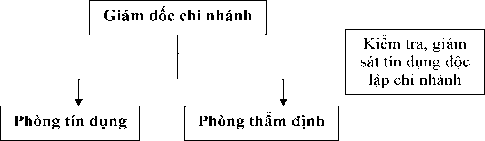
Diagram 4.1: Diagram of the organizational structure of the credit management apparatus at the branch
(Source: Author's proposal)
According to this model, Agribank Thai Nguyen branch separates business functions (customer contact, marketing, customer care), credit analysis functions (analysis, appraisal, forecast, customer evaluation) and operational functions (processing records, monitoring, supervising loans, debt collection, interest collection). Therefore, this model will improve the efficiency and management capacity of the bank, especially credit risk management.
+ The internal inspection and control department or the officer concurrently in charge of independent credit inspection and supervision at Agribank Thai Nguyen branch has the following tasks:
- Assess the risk level of the credit portfolio and risk management process from the business perspective of each functional department at the Branch.
- Regularly inspect and evaluate the strict compliance with the laws, regulations of the State Bank of Vietnam and regulations and policies of Agribank in the credit sector at the branch to promptly detect violations, deviations and shortcomings in credit activities, thereby proposing effective corrective and remedial measures.
- Periodically conduct inspections and controls on credit activities at the branch.
- Propose preventive measures to avoid new violations.
- Make recommendations for improving policies, regulations, and procedures to the Research and Implementation Operations Center.
- Act as a contact point and coordinate work with the Operations Center's inspection and audit, external and State Bank inspection.
- Make reports according to the department's functions and tasks periodically or suddenly as required by the Director and the Operations Center;
+ Credit Department (Business Planning Department and Household and Individual Planning Department)
- Identify target business market and target customers
- Develop customer policies, directly participate in implementing customer policies and evaluate customer policy implementation.
- Directly implement marketing measures to introduce to customers products and services that Agribank has advantages in and can provide.
- Organize regular customer policy implementation assessments to promptly propose policy adjustments or more effective implementation measures when necessary.
- Directly initiate and manage credit relationships with customers.
- Depending on the specific characteristics of each customer, coordinate with other departments to design suitable and attractive products for customers.
- Perform other tasks assigned by superiors.
- The customer relations department will search, develop and take care of customers, understand customer needs, guide customers to complete loan applications, then transfer all customer files and information to the credit analysis department.
+ Appraisal room
- Develop credit risk management policies
+ Do not concentrate too much credit on 1 customer, 1 industry, field, customer groups, related industries, fields, 1 currency and in 1 location.
+ When deciding to grant credit to a project, it must be done collectively, ensuring objectivity.
+ Apply credit limit and credit term depending on branch capacity.
- Portfolio management
- Directly assess RR of each credit granted to customers.
- Participate in the credit approval process, participate in and monitor the implementation of approved decisions, participate in handling problematic credit loans.
- Other tasks assigned by superiors.