
Strong and warm ocean currents not only create rich fishing grounds but also provide a natural route for Japan to communicate with neighboring countries. Vietnam is a country with a particularly favorable location for communication and development, welcoming the introduction of different cultures.
The famous Japanese historian, Professor Watabe Tadaio, believes that in the high mountainous regions of Laos, the North and Northeast of Thailand, a part of Than and Khoxin states of Myanmar, a part of Guangxi, Yunnan China, the East of Assam state of India, the North and Central of Vietnam, and even Japan... until before the 10th century, the custom of eating sticky rice was popular, so the residents in that area were all influenced by the "cultural cycle of eating sticky rice and drinking tea" . [21], pp.108-111]
On that common cultural and nuanced basis, the diplomatic relationship between Vietnam and Japan, although not yet taking place regularly, is still recorded in the historical sources of the two countries.
Since the mid-eighth century, there were monks from the kingdom of Lâm Ấp, a land in present-day Vietnam, who came to Japan. Coincidentally, during that time, Fujiwara No Kiyokawa, Abe No Nakamaro and some other members of the Japanese embassy were the first Japanese to come to Vietnam, to learn about the country, culture and customs of the Vietnamese people. [5]
History also records the heroic and courageous spirit of the Vietnamese and Japanese people in their struggles to maintain national independence. At the end of the 13th century, the Yuan-Mongol empire carried out an aggressive and expansionist policy against many countries in the world. As countries adjacent to China, Vietnam and Japan naturally became the targets of conquest by the Yuan Dynasty. In the years 1258, 1285 and 1287, Vietnam was invaded by the Yuan-Mongol three times, but thanks to the spirit of "king and subject are of one mind, brothers are in harmony, the whole country contributes its efforts" , the army and people of Dai Viet won glorious victories, protecting the integrity of sovereignty and national independence. As for Japan, in the years 1274 and 1281, the Yuan Dynasty also twice sent troops to invade Japan, facing the extremely heroic resistance of Japanese warriors and militias and was hit by major storms (Divine Winds).
Maybe you are interested!
-
 Limiting social insurance debt of businesses by applying sanctions Case study of businesses in Thanh Xuan district, Hanoi city - 12
 -
 Applying Local Marketing in Bac Ninh Tourism Development - 2
 -
 Concept and Objective Necessity of International Trade Finance Activities:
 -
 Procedure for Applying Law in Criminal Investigation Cases
 -
 Applying a Suitable Port Investment and Operation Management Model
Many warships sank, and the Yuan army finally had to retreat. This proves that the people of both countries share the same fighting spirit, the same courage, the same courage to face difficulties, and the same national pride with a passionate patriotism.[5]
On the other hand, Vietnam and Japan are two countries that are strongly influenced by Confucianism. Ethical business and management philosophy are inherited from the application of Confucian doctrines. Among them, two prominent ideas, applied in life and business practice, are " What you do not want, do not do to others " (ky so bat duc vat thi u nhan) and " If you want to stand firm, make others stand firm, if you want to succeed, also make other people's work successful" (ky duc lap nhi lap nhan, ky duc dat nhi dat nhan). The above viewpoints have promoted business associated with ethics, praised real business talents, affirmed the desire for wealth and compassion must always go hand in hand. The above are like a compass for businesses to consider when building corporate culture and also become the standard for selecting and using people in the business.
2.2. Differences
Due to cultural differences, Japanese people emphasize similar groups, so it is easy to reach consensus in group decisions, and before doing anything, all groups must have the same opinion, group members are afraid of arguing and opinions are often based on constructiveness. Japan is a society that always emphasizes "We" instead of "I". Important decisions are often discussed and only when there is consensus are they made. Also, because all results are the efforts of a group, it would be inappropriate to praise a specific individual. However, cooperation and reaching a common opinion are difficult for Vietnamese people, this is explained by the lack of discussion in Vietnamese education and sometimes the "I" makes it difficult to reach a common opinion.
The image of “A big family” is carefully nurtured by Japanese enterprises, the closeness and intimacy like parents and brothers among members of the Company is something that Vietnamese enterprises have not yet built.
due to the habits of the Vietnamese people's lifestyle in the past and the current businesses themselves have not paid much attention to this issue. However, this is a basic element of Japanese corporate culture, the foundation for building other values.
3. Typical application of Japanese corporate culture in Vietnam
In this section we will study more closely FPT Software Joint Stock Company (FSOFT) - a typical example in applying Japanese corporate culture in Vietnam.
3.1. Introduction to FSOFT
FPT Software Joint Stock Company is often called FPT Software or simply FSOFT. Currently, this company is considered one of the leading companies in Vietnam in software export.
FSOFT is one of the member companies of FPT Group, established in 1988 with the initial scale of only an IT department called ISC (Informatic Service Center). In late 1998 and early 1999, after the software export strategy was shaped, a group of experts was separated from FSS to establish FSU1 (FPT Strategic Unit #1) as the spearhead department in the Globalization mission. FSU1 is the predecessor of today's FSOFT. In 1999, FSOFT successfully implemented the first project with Winsoft, Canada, initially determined the organizational structure, developed programs to prepare human resources for export and 1999 is considered the founding year of FSOFT. Through the process of formation and development, in 2004, FPT Software Joint Stock Company was officially established.
Figure 2.3: FSOFT's organizational structure
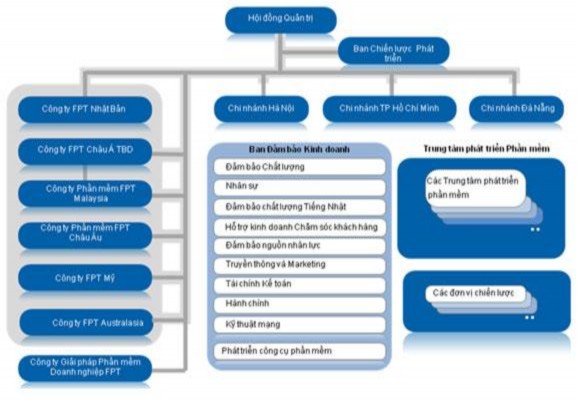
Source: FSOFT Company Website ( http://www.fpt-soft.com )
3.2. The necessity of applying Japanese corporate culture at FSOFT
Some milestones can be mentioned regarding the cooperation situation between FSOFT and Japanese partners.
2001 was marked by OSDC contracts with NTT-IT - FSOFT's first Japanese customer.
2003 brought FSOFT many new customers, especially big Japanese customers such as Hitachi, Sanyo, Nissen, IBM Japan. FSOFT established an office in Ho Chi Minh City.
In 2004, when FSOFT was officially established, FSOFT opened a representative office in Tokyo to better serve Japanese customers. In November 2005, FPT Software Japan Company was established in Tokyo. On September 13, 2008, it changed its name from FPT Software Japan (FSJ) to FPT Japan (FJP) and on November 13, 2008, FJP celebrated its 3rd anniversary.
As of 2008, FSOFT had 15 production units, 10 of which served the Japanese market.
In the software field where FSOFT is participating, Japan has a strategic position as shown in the following aspects: it is a major export market, a technology transfer partner and helps improve the capacity of domestic software enterprises, and is a long-term customer of this industry.
Japanese enterprises were the first partners and have since been the largest partners, accounting for 61% of FSOFT's export processing turnover (Figure 2.4).
With the requirements of Japanese enterprises for partners, FSOFT has creatively applied Japanese corporate culture to its business, both to create trust for partners and to develop the Company's own corporate culture.
3.3. FSOFT's VHDN
FPT Vision (FPT Charter 1988)
FPT wishes to become a new type of organization, rich and powerful, through hard work, creativity in science, engineering and technology, satisfying customers, contributing to national prosperity, bringing each of its members the best conditions to develop their talents and a life full of material and spiritual richness.
FSOFT's Mission
As a pioneer in FPT's Globalization, FSOFT wishes to grow quickly and strongly so that in the not too distant future, on the World Intellectual Map, there will be the name Vietnam, there will be the name FPT.
FSOFT's core values
Core values are extremely valuable assets that every FSOFT person cherishes and preserves.
Customer Satisfaction: Be dedicated to customers and always strive to best meet their needs and exceed their expectations.
People are the core: Respect people, create conditions for members to develop their talents to the fullest, contribute to the organization and be treated fairly in terms of both
material and spiritual
Best Quality: Ensure the best quality in every product, every job.
Upholding business ethics: Each employee is a representative of the Company, has the obligation to comply with the highest business ethics, always cooperate, be open and friendly with colleagues, and contribute to the community and society.
FSOFT's corporate culture, like that of other businesses, is influenced by traditional cultural factors, imported culture, group culture, founders, leaders, etc. However, besides that, FSOFT has a distinct feature of being influenced by FPT's corporate culture and the culture of its largest business partner - Japanese corporate culture.
FPT Corporation is considered the enterprise with the strongest culture in Vietnam (See Appendix 1), but within FPT Corporation, FSOFT is considered the unit with the strongest culture.
Figure 2.4: Chart of FSOFT's export market structure

13%
6% 10%
10%
61%
Japan America
Asia Pacific Vietnam
EU
Source: Profile FSOFT Jan – 09 , http://www.fpt-soft.com/
Due to the specificity of the market and customers, Japan is a partner that accounts for 61% of FSOFT's export value (see figure 2.4), and FSOFT is one of the enterprises that applies a lot of Japanese corporate culture into its production and business activities. To be able to affirm that FSOFT has applied Japanese corporate culture, we
We can study some aspects as follows:
In the introduction of FSOFT's culture posted on the Company's official website, it is mentioned: "With the characteristic of regularly working with foreign customers, FSOFT always focuses on researching and importing unique cultural features of other countries, while maintaining the Vietnamese cultural identity and introducing it to its customers and partners." This has been proven in the practice of building FSOFT's corporate culture, paying great attention to the corporate culture of its partners and paying the most attention to Japanese corporate culture.
The importance of Japanese partners is first shown on the company's main website http://www.fpt-soft.com/ which is displayed in two languages: English and Japanese. Right in FSOFT's headquarters in Vietnam, FSOFT has built very Japanese cultural corners such as Japanese gardens, tea ceremony rooms... to serve employees.
Japanese cultural activities
FSOFT is very enthusiastic about participating in cultural activities related to Japan (Japanese language festivals, Sakura festivals, concerts, film screenings or Japanese culture introductions...). FSOFT is very enthusiastic about participating. The company also regularly organizes similar internal activities. The company hopes that, from understanding Japanese culture in general, it will better understand Japanese corporate culture, be closer to customers, gain more trust from customers and... earn more money. As for employees, this is both helpful for their work and also a form of entertainment.
Employee working style
With a large number of Japanese customers, communication between the Company's employees and Japanese partners is something that FSOFT is very concerned about. During the working process, FSOFT employees must comply with all that is considered Japanese culture such as: Email writing culture, Hourensou culture, serious and responsible working style...
Staff
To develop the Japanese market, since 2005 FSOFT has implemented a program
The major programs implemented include the establishment of Dong Du Center to train Japanese in information technology, recruiting students from Japanese departments and supporting scholarships for them to study at Aptech, recruiting graduates from information technology schools and providing 6-month intensive Japanese training. Since then, these support activities have always been maintained to create for FSOFT a team of highly qualified staff who are also knowledgeable about Japanese corporate culture.
At FSOFT, because we work on projects with Japan, there are many documents that need to be translated for communication between the two sides. Conferences and projects also need translators, so there is a very strong team called Japanese Communicator (Comtor). This Comtor team comes from Foreign Trade University, Hanoi University, National University, Thang Long University, and are students who studied Japanese during their university years. They love Japanese and its culture, so they contribute to the implementation of VHDN application.
Comtor is not simply understood as an interpreter, comtor is also a BA (Business Analyst) and a person who knows Japanese culture, so they can know the taboos in communication, what to say, what to avoid during the translation process. Due to the nature of FSOFT, comtors must also understand business, have basic knowledge of the Company's field of operation, and a variety of professions. For example, if they have to translate photos with text, comtors must also be graphic designers... Comtors are also required to know how to plan and assign work professionally, no less than employees in other departments.
At FSOFT (Hanoi), there is a Japanese woman named Suzuki (very good at Vietnamese), who leads a department called JQA (Japanese quality assurance), carrying out activities related to Japanese language and culture in the company, and managing the Comtor team in the whole company.
Employee care
This is a very typical feature of Japanese businesses, between leaders and employees there is a close bond like a family, sharing everything. This is what makes employees attached to the business and willing to contribute more.
The first thing can be shown through the days of honoring. Every year FPT organizes the days of honoring women: March 8 and October 20. For brothers