
In Vietnam, that is the case of Viet My Limited Liability Company and Quang Minh Limited Liability Company producing two types of green tea with the brands O2 and Ω green tea with signs of duplication, similar to the 0 degree green tea brand of Tan Hiep Phat Company.
Tan Hiep Phat Company's 0 degree green tea has been granted a Certificate of protection for trademarks, designs and packaging models by the Intellectual Property Office. The 0 degree green tea brand includes: the Number One logo and the large 0 degree letters on the label. Currently, this product line has a very strong consumption in the beverage market, accounting for over 40% of the company's beverage market share. Taking advantage of the existing reputation of the 0 degree green tea product in the market, Viet My Company has produced green tea under the O2 brand with color signs, packaging, and brand presentation on the product packaging identical to the 0 degree green tea brand of Tan Hiep Phat Company. Next, the market continued to see the appearance of green tea products under the Ω brand of Quang Minh Company with signs similar to the 0 degree green tea brand of Tan Hiep Phat.
In the face of the above incident, Tan Hiep Phat Company intended to sue Viet My Company and Quang Minh Company in court for trademark infringement. However, in response to the public apology of the two violators, Tan Hiep Phat Company canceled the decision to sue the two companies, in exchange for the two companies being forced to commit to recalling counterfeit products bearing the O2 and Ω trademarks that were circulating on the market until August 4, 2007. In total, more than 30,000 bottles of O2 green tea were recalled and destroyed. The Ω green tea products have not yet been released to the market, however, Quang Minh Company also committed to destroying all bottles and labels that were planned to be released to the market.
Garment market
One of the markets where unfair competition involving trademarks with sophisticated tricks often occurs is the garment market. The more prestigious the product, the more counterfeit goods with identical or similar trademarks appear, causing confusion. Viet Tien Garment Company in Ho Chi Minh City, under the Vietnam Garment Corporation with products bearing the trademark “VIETTIEN” is a typical example of the above phenomenon. Since 2000, the trademark “VIETTIEN” has been blatantly “borrowed” although it has been registered for protection. To date, there are about 90 stores selling counterfeit goods bearing the trademark “VIETTIEN”, 12 stores violating the signboard. Recently, Viet Tien Garment Company has requested to prosecute a facility in Hanoi and has seized over 22,000 counterfeit products of the “VIETTIEN” brand and, together with the authorities, seized 21 machines for making counterfeit goods and a large number of related accessories[39]. Although Viet Tien Garment Company has paid more attention to handling the above unfair competition acts, up to now, the Company has only been able to handle 70% - 80% of intellectual property rights violations in general, together with the authorities.
Construction materials market
The construction materials market also has many cases of unfair competition related to product trademarks.
The recent unfair competition case involves the steel trademark “Viet Nhat” owned by Hai Phong Steel Joint Stock Company (HPS), located at Km 6, National Highway 5, Quan Toan Ward, Hong Bang District, Hai Phong City. The steel trademark “Viet Nhat” is protected under the Certificate of Trademark Registration No. 43649 for steel products in group 06.
Certificate of trademark registration as follows:
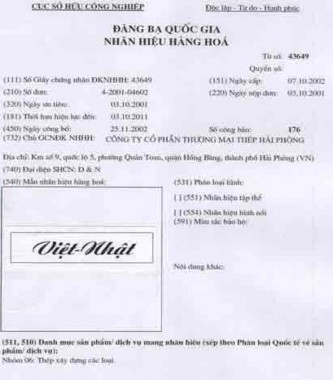
Figure 2.5. Certificate of trademark registration[33]
However, after a while, Viet Nhat Steel Joint Stock Company, Le Chan District, Hai Phong City, produced and circulated steel products with the same trademark as the "Viet Nhat" trademark that had been granted a Certificate of Protection by Hai Phong Steel Joint Stock Company (HPS). Furthermore, the Company also used a trade name that was the same as the trade name of HPS. This case was received and resolved by the Department of Intellectual Property and determined that this was an act of unfair competition. Therefore, Hai Phong Steel Joint Stock Company (HPS) can completely go to the competent authorities to request the implementation of measures to handle this act of unfair competition.
Thus, through studying some typical unfair competition cases related to trademarks in recent times in Vietnam, it can be seen that unfair competition related to trademarks occurs and infiltrates.
In all economic sectors, the more profitable the production and business sectors are, the more prestigious the brands are in the market, the more illegal production and business enterprises infringe.
2. The number of unfair competition cases related to trademarks shows signs of increasing gradually.
Unfair competition acts related to the field of industrial property in general and trademarks in particular are not only expanding in scope but the number of violations is also showing signs of increasing significantly.
Table 2.1. Unfair competition cases related to the field of IP in the period 2004-2006
Five Subjects
2004 | 2005 | 2006 | |
Brand | 22 | 21 | 26 |
Industrial design | 0 | 0 | 5 |
Invention | 0 | 0 | 0 |
Maybe you are interested!
-
 Unfair Competition Regarding Trademarks
 -
 General Overview of Promotions Aimed at Unfair Competition
 -
 Factors Affecting the Development and Implementation of Laws on Combating Unfair Competition in Banking Activities
 -
 Cases Where Civil Court Fees Are Not Required or Exempted and Related Procedures
 -
 Sanctions for Promotional Behavior Aimed at Unfair Competition
Source: Enforcement and Complaints Settlement Department - Vietnam National Office of Intellectual Property Thus, previously, when industrial property appraisal belonged to
Regarding the responsibilities of the Intellectual Property Office, the Department's enforcement and complaint settlement department has received and assessed many unfair competition cases related to the industrial property sector. Among them, unfair competition cases related to trademarks always account for the largest proportion and tend to increase over the years. In 2004, the number of unfair competition cases was 22, by 2006, this number had increased by 18% with 26 violations.
By the end of 2006, in order to meet the requirements of the international economic integration process as well as the requirements of the World Trade Organization (WTO), the National Office of Intellectual Property no longer takes responsibility for industrial property appraisal, but this work is transferred to the grassroots enforcement agencies. However, with the function of establishing industrial property rights through the issuance of Protection Certificates, the Enforcement and Complaints Department of the National Office of Intellectual Property has received many complaints about unfair competition related to trademarks. Moreover, the number of trademark registration applications rejected due to the use of identical or similar signs, causing confusion with related trademarks or with other industrial property objects such as: trade names in use; geographical indications, industrial designs... that have been granted Protection Certificates or have an earlier priority date or application filing date has also shown signs of increasing significantly.
Table 2.2. Number of third-party complaints regarding the issuance of a Certificate of Registration
by insurance
Year
Object
2006 | 2007 | 2008 | |
Brand | 547 | 631 | 673 |
Industrial design | 3 | 4 | 8 |
Invention | 0 | 1 | 0 |
Source: Enforcement and Complaints Settlement Department - Vietnam National Office of Intellectual Property Thus, looking at the above data table, we can see that the label
Trademarks are always the industrial property objects with the most complaints about the granting of Certificates of Protection. Moreover, over the years, the number of third-party complaints about the granting of Certificates of Trademark Registration has also increased gradually.
This shows that the number of trademarks requiring registration showing signs of unfair competition is on the rise.
3. The tricks of unfair competition related to trademarks are increasingly sophisticated.
Not only are the number of cases of counterfeiting or imitation of trademarks increasing, but the methods of unfair competition are also becoming more and more sophisticated, using all means to deceive consumers. The acts of counterfeiting and imitation of trademarks are so sophisticated that even the businesses that produce the infringed goods cannot detect them. When they are discovered, although there are some remedies, they are insignificant, and many businesses have to live with counterfeit goods.
Many counterfeit brands are very sophisticated, similar to genuine brands down to every detail. Only by checking the barcode on the product label can one distinguish between genuine and fake goods.
Violating businesses often use raw materials of unknown origin to produce products, then attach counterfeit trademarks to those goods to deceive consumers about the true origin of the goods.
Furthermore, the tricks and schemes to bring goods with trademarks that violate industrial property rights from abroad into the Vietnamese market are becoming more and more sophisticated. For example, violators often take advantage of carry-on luggage to import small-sized items, entering through many different border gates, making it difficult for trademark owners to promptly request customs authorities to suspend procedures.
More worryingly, many subjects who infringe on trademarks are officials of state-owned enterprises with production and business functions or distribution agents, and even branded manufacturers.
4. Causes
In Vietnam, the situation of infringement of industrial property rights on trademarks by unfair competition is increasing due to the following main reasons:
Firstly, the production and trading of counterfeit goods and counterfeit trademarks always bring the subjects profits many times higher than having to invest in building a new trademark for the products that appear on the market for the first time of the enterprise. Therefore, currently, unfair competition acts related to trademarks are carried out by many subjects, including pure workers, in many different areas and fields.
Second, in the current economic conditions, the average income of consumers is still low, while the prices of products serving daily needs are quite high. This imbalance has caused consumers to tend to choose goods with designs similar to reputable products but at very low prices. Taking advantage of this situation, many manufacturing and trading enterprises are willing to counterfeit goods, using similar trademarks that can easily be confused with famous trademarks for the purpose of increasing business profits. This is the main reason leading to the increasing situation of unfair competition related to trademarks.
Third, the subjects of production and business of goods and services are not fully aware of protecting their rights by registering for trademark protection. Moreover, the level of awareness of the harmful effects of unfair competition on the public interest is still limited. Currently, very few enterprises have a specialized department in the field of intellectual property, considering intellectual property as part of their development strategy.
Fourth, unfair competition acts in the field of industrial property in general and related to trademarks in particular, as well as measures to handle these violations have not been centrally and uniformly regulated in a single legal document but are still scattered in many different effective legal documents, creating many loopholes in practical application. In addition, enforcement agencies in handling unfair competition related to industrial property in general and trademarks in particular sometimes have overlapping tasks and functions. The enforcement staff is still lacking and their capacity is weak .
II. Current status of unfair competition handling activities related to trademarks in Vietnam
1. Current status of laws against unfair competition related to trademarks in Vietnam
1.1. International law
Currently, Vietnam has joined the following basic international conventions with provisions on handling unfair competition acts related to the field of industrial property in general and related to trademarks in particular:
Paris Convention 1883 for the Protection of Industrial Property. Vietnam became a member of the Convention on March 8, 1949.
Agreement on Trade-Related Aspects of Intellectual Property Rights (TRIPS Agreement). Vietnam became a member of the TRIPS Agreement on November 7, 2006.
Stockholm Convention 1967 establishing the World Intellectual Property Organization WIPO. Vietnam became a member of the Convention on July 2, 1976.